

Goldman Sachs’ US economics team believes the upcoming Federal Open Market Committee (FOMC) meeting is unlikely to produce major policy shifts. According to the firm’s latest research, the Federal Reserve is expected to keep interest rates unchanged this week while avoiding any strong new signals that could trigger market volatility.
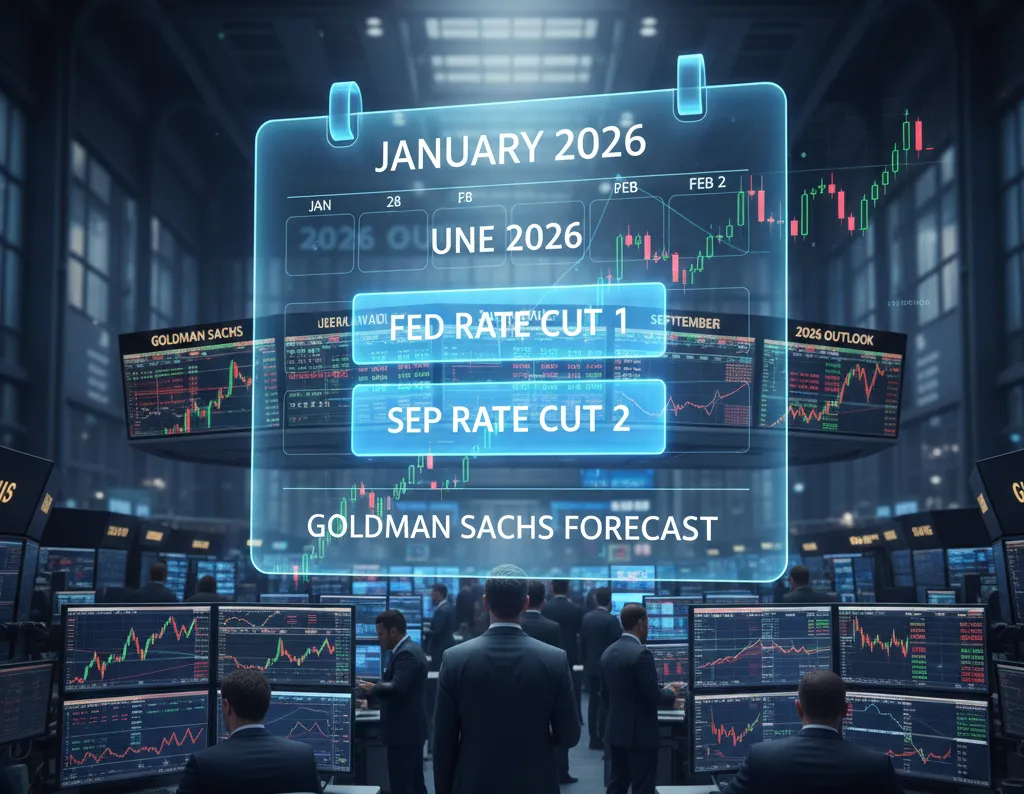
While the short-term outlook suggests a period of “patience,” Goldman Sachs remains firm in its projection that the Fed will deliver two interest rate cuts later in 2026.
Why the January FOMC Meeting May Be Uneventful
Goldman Sachs economists, led by Chief US Economist David Mericle, note that current economic data does not necessitate immediate action. While inflation has moderated significantly from its 2024-2025 peaks, it has yet to reach the Fed’s sustainable 2% target.
The Current Economic Balance:
- Inflation: Core PCE is estimated to fall toward 2.1% by December 2026, but the “last mile” of disinflation remains slow.
- Labor Market: The unemployment rate has stabilized around 4.4%–4.5%. Strength in non-farm payrolls has reduced the urgency for a “rescue” cut in Q1.
- Market Sentiment: With investors already pricing in a “hold” for January, the Fed is likely to repeat its data-dependent stance, emphasizing that they are in no rush to ease.
The 2026 Rate Cut Timeline: June and September
Despite the expected pause this week, Goldman Sachs recently revised its 2026 timeline. The firm moved its forecast for the first rate cut from March to June 2026, citing a resilient economy and the potential impact of fiscal policies like the “One Big Beautiful Bill” tax cuts.
Goldman Sachs 2026 Forecast Table
| Period | Expected Fed Action | Projected Fed Funds Rate |
| January – April 2026 | Steady / Hold | 3.50% – 3.75% |
| June 2026 | 25bps Rate Cut | 3.25% – 3.50% |
| September 2026 | 25bps Rate Cut | 3.00% – 3.25% |
| Year-End 2026 | Neutral Stance | 3.125% (Median) |
Three Key Drivers the Fed is Watching
According to the Goldman report, the “pivot” to rate cuts in June will depend on three specific variables:
1. AI-Driven Productivity
A major theme for 2026 is the surge in AI integration. Goldman expects this to boost GDP growth to 2.5% (Q4/Q4). Higher productivity allows the economy to grow without triggering inflation, giving the Fed more “room” to cut rates.
2. The “Jobless Growth” Risk
While GDP is strong, job growth has slowed. If the labor market softens further than the current 4.5% unemployment forecast, the Fed may be forced to move more aggressively than the two-cut base case.
3. Fiscal Policy Tailwinds
The transition from tariff-driven price pressure to tax-cut-driven growth is a primary reason for the Fed’s cautious start to the year. Goldman believes tax incentives will sustain consumer spending, allowing the Fed to maintain higher rates for longer than previously expected.
The Bottom Line for Investors
The January FOMC meeting is an important checkpoint, but it is likely not the “main event.” Goldman Sachs’ outlook suggests the real story of 2026 will unfold in the middle of the year.
For investors in rate-sensitive sectors—such as real estate, small-cap stocks, and banking—the focus should remain on the June and September windows. As long as inflation stays on its current cooling path, the “higher for longer” era may finally start to thaw this summer.
Stay ahead of the markets. Bookmark our Federal Reserve Calendar for weekly updates on data releases and policy shifts.
