
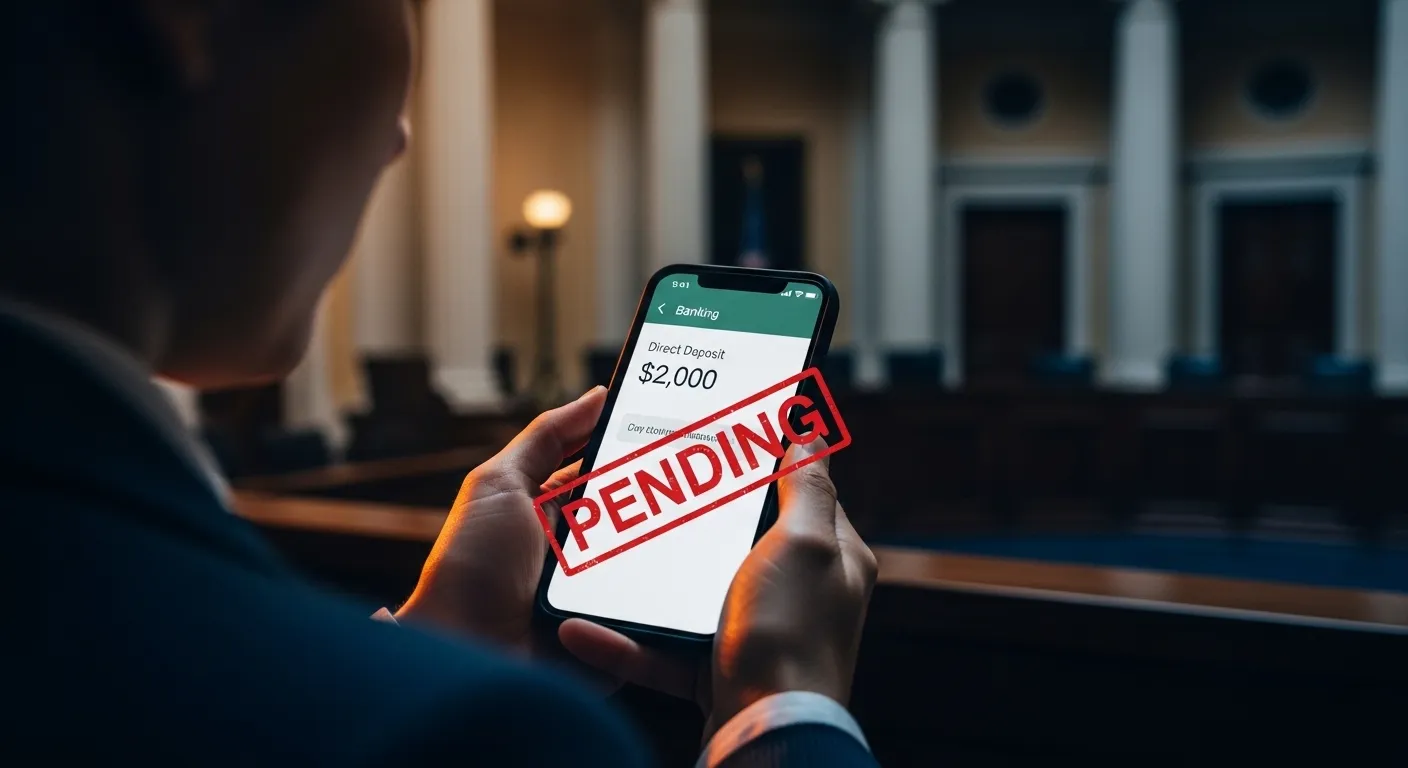

If you’ve been glued to your phone waiting on a $2,000 direct deposit, you’re not alone. This is arguably the most searched financial topic in the country right now — and for good reason. The promise came straight from the White House, so people want to know if it’s real.
Here’s where things actually stand: eligibility for $2000 direct deposit is currently in a legal holding pattern. The payment was proposed, the framework was discussed, and millions of Americans started planning around it. Then, on February 20, 2026, the Supreme Court stepped in and changed everything.
This isn’t a scam story. This isn’t misinformation. This is an honest breakdown of what happened, what it means for your bank account, and what you should actually be doing right now.
The Supreme Court Ruling: What Just Happened?
The IEEPA Decision Explained
The White House’s original plan was to fund the $2,000 “Tariff Dividend” — essentially sending Americans a share of the money collected through import tariffs — using executive emergency powers under the International Emergency Economic Powers Act (IEEPA).
On February 20, the Supreme Court ruled that the President cannot use those emergency powers to fund direct payments to citizens through tariff revenue. In other words, the legal shortcut that would have bypassed Congress was shut down.
Think of it this way: the administration tried to use a side door to get this money out quickly, and the Court just locked that door.
The $175 Billion Budget Gap
This ruling creates a serious financial headache. The tariff revenue that was earmarked for these checks — estimated around $175 billion — may now need to be refunded to the importers who paid it. That’s not pocket change. That’s an enormous hole in the entire funding plan, and there’s no clear replacement budget sitting on the shelf right now.
What the White House Is Doing Next
The administration hasn’t gone quiet. Officials are now exploring two “Plan B” routes: the Trade Act of 1974, which grants different presidential authority over trade-related spending, and going directly to Congress to get a bill passed. Neither path is fast, and neither is guaranteed.
Rumors vs. Reality: What Is Actually Law Right Now?
Let’s cut straight to it.
No Law Has Been Signed
As of today, February 23, 2026, there is no signed law that authorizes a $2,000 payment to anyone. The Tariff Dividend was a proposal — a well-publicized one — but it never made it through the legislative process before the Supreme Court ruling complicated the funding mechanism entirely.
Any website, social media post, or text message telling you your money is “approved” or “ready for claim” is either dangerously wrong or an outright scam.
Congress Now Holds the Keys
For a $2,000 payment to actually hit bank accounts, it almost certainly needs a full Congressional vote. That means the House, the Senate, and the President’s signature. That process takes time — sometimes months — especially with a divided legislative agenda and ongoing budget battles.
The Midterm Election Angle
A lot of policy analysts are now pointing to late 2026 as the more realistic timeline, and the reason isn’t subtle. The November midterm elections create a strong political incentive to push this payment through closer to voting season. A $2,000 check landing in bank accounts weeks before an election isn’t just good policy optics — it’s a known political strategy. Whether that’s a cynical read or a practical one depends on your worldview, but either way, it shifts the likely timeline from “soon” to “probably fall 2026 at the earliest.”
Why Eligibility Information Still Matters Right Now
The Proposed Criteria Haven’t Changed
Even though the funding is blocked, the eligibility for $2000 direct deposit framework that’s been circulating is still the baseline for any future bill. The income limits being discussed are:
- Single filers: Up to $75,000 adjusted gross income
- Joint filers (married couples): Up to $150,000 adjusted gross income
Payments would phase out above those thresholds, similar to how the COVID stimulus checks worked. If Congress drafts a new bill, these numbers are the starting point — though lawmakers could adjust them during negotiations.
Why Keeping Your IRS Info Updated Still Makes Sense
Here’s a practical reason not to completely check out from this topic: if a bill does pass, it could move quickly. The IRS has advised people to keep their direct deposit information current in their Individual Online Account at IRS.gov. If a payment is authorized and your banking info is outdated, you could be stuck waiting for a paper check — which historically takes weeks longer than direct deposits.
It takes about five minutes to verify your info. It’s worth doing regardless of whether this payment ever comes through, since the IRS uses that same information for tax refunds.
SCAM ALERT: Tariff Dividend Fraud Is Spiking
This section might be the most important thing you read today.
The Fake Text Messages Going Around
Scammers don’t wait for laws to be signed. They move the moment a story gets hot — and this story is burning. Right now, people across the country are receiving text messages that say things like:
“Your $2,000 Tariff Dividend has been approved. Click here to verify your bank account and receive your payment.”
Do not click. Do not reply. Delete immediately.
The IRS and the Treasury Department do not contact people via text message to distribute federal payments. Period.
The “Processing Fee” Trick
A variation of this scam asks you to pay a small “processing fee” — usually $25 to $50 — to “unlock” or “release” your payment. This is one of the oldest con tricks in the book, repackaged for 2026.
No legitimate federal benefit requires you to pay anything upfront to receive it. If someone is asking you for money before giving you money, that’s a scam. Every single time.
Scammers Are Using the IRS Direct Deposit Mandate as Bait
In 2026, the IRS has been pushing harder for people to use direct deposit for all tax-related payments. Scammers are using this real policy shift to add legitimacy to their pitch — telling victims they “must update their banking info now” due to a “new federal mandate.” They then collect routing numbers and account numbers, and the victim’s account gets drained.
If you receive any communication asking for your banking information in connection with a $2,000 payment — by text, email, phone call, or social media message — report it to the FTC at ReportFraud.ftc.gov and to the IRS at phishing@irs.gov.
What Should You Do Right Now?
Step 1: Don’t Spend Money You Don’t Have Yet
This sounds obvious, but people are making real financial decisions — delaying bill payments, passing on putting money into savings — based on a payment that has no legal authorization yet. Until a bill is signed into law, treat this $2,000 like it doesn’t exist in your budget.
Step 2: Focus on Benefits That Are Already Real
While the Tariff Dividend remains in limbo, there are actual credits and deductions moving through the One Big Beautiful Bill (OBBB) that could affect your finances in 2026. These include:
- Enhanced Child Tax Credit — expanded amounts that could put more money back in families’ pockets during tax season
- Car Loan Interest Deduction — a new deduction being proposed for interest paid on auto loans for American-made vehicles
These are worth understanding now because they affect your 2026 tax filing, regardless of what happens with the $2,000 payment.
Step 3: Watch the State of the Union Address
The President is scheduled to address Congress on February 24, 2026 — tomorrow. This is widely expected to be the moment the administration lays out its official “Plan B” for the payment. Will they push a congressional bill? Will they announce a revised executive order? Will they quietly shelve the whole thing?
This address will likely give the clearest picture yet of whether — and when — any payment is actually coming.
FAQ
Is the $2,000 direct deposit confirmed for 2026?
No. As of February 23, 2026, no law authorizing this payment has been signed. The Supreme Court blocked the original funding mechanism on February 20, and the administration is now working on alternative approaches.
Do I need to apply or register to receive the $2,000 if it’s approved?
Based on the proposed framework, no application would be required. The payment would be distributed automatically using IRS tax return data, similar to previous stimulus payments. This is why scammers asking you to “register” or “verify” your account are fraudulent.
What are the income limits for eligibility for $2000 direct deposit?
The proposal targets individuals earning up to $75,000 and married couples earning up to $150,000 in adjusted gross income. These figures may change if Congress writes a new bill.
