
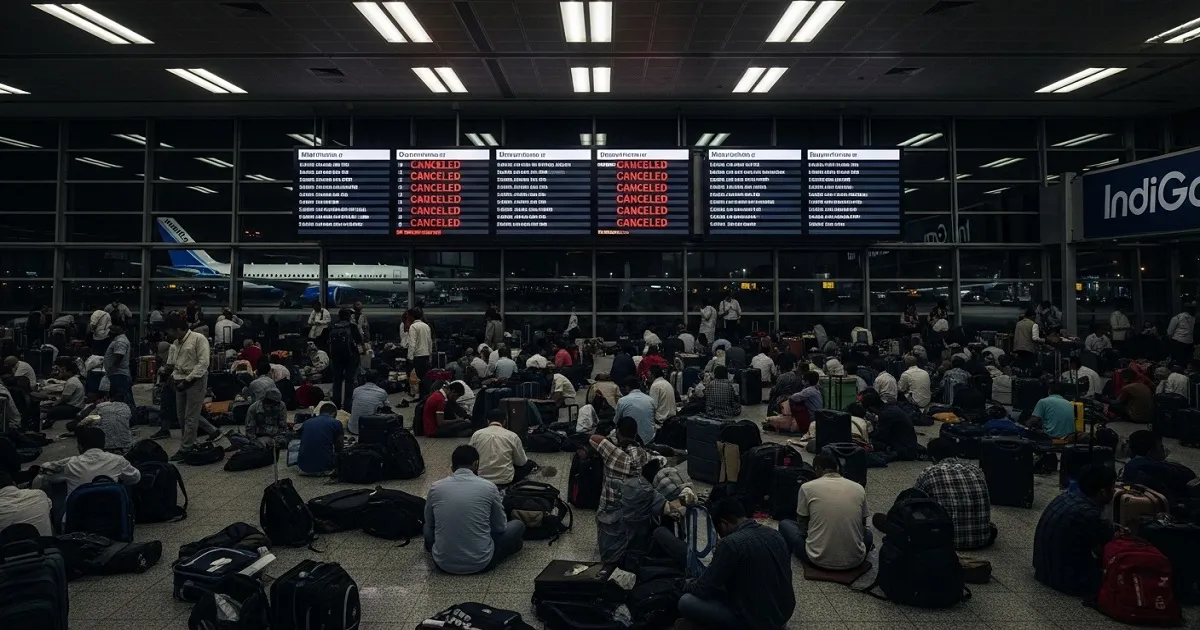

India’s largest carrier, controlling nearly two-thirds of the subcontinent’s skies, is caught in the middle of a full-blown crisis — and it’s only getting bigger.
The Meltdown That Shook Half a Million Passengers
It started in early December 2025. IndiGo — the airline that dominates Indian aviation the way American Airlines dominates the U.S. — suffered what Bloomberg described as an “unprecedented meltdown.” Pilot shortages collided with software glitches, and the result was catastrophic: thousands of flight cancellations and over 500,000 stranded passengers in one of the worst aviation disasters in Indian history.
By the end of December, more than 9.82 lakh passengers (nearly one million) had been impacted by IndiGo cancellations alone, and the airline’s market share fell from 63.6% in November to 59.6% in December.
The chaos didn’t just strand travelers. It triggered government intervention, regulatory punishments, and a financial reckoning that is still playing out.
The Regulator Cracked Down — Hard
India’s aviation watchdog, the DGCA (Directorate General of Civil Aviation), didn’t stay silent. IndiGo has vacated more than 700 slots at various domestic airports, following the DGCA curtailing the airline’s winter flights by 10% as punishment for the operational chaos. The airline was also directed to reduce its flight schedule through March to comply with new crew duty regulations — a direct response to the pilot shortage crisis.
Separately, DGCA granted only limited relaxation to IndiGo for night operations until February 10, while weekly rest norms for pilots remain mandatory and unchanged.
Profits Collapsed — But Revenue Hit a Record. Go Figure.
Here’s the twist that has Wall Street and investors buzzing: IndiGo’s parent company, InterGlobe Aviation, reported a 77.5% year-on-year decline in net profit for the third quarter of fiscal year 2026 — yet somehow, revenue from operations rose 6.2% year-on-year to INR 23,472 crore (approximately $2.55 billion USD), driven by an 11.2% increase in capacity.
In other words: IndiGo is flying more passengers than ever, making record revenue — and losing money doing it.
CEO Pieter Elbers tried to put a positive spin on it, saying the airline “welcomed nearly 32 million customers this quarter and 124 million in calendar year 2025, a new record.” But a 77.5% profit drop is hard to spin.
The International Dream Is Already Hitting Turbulence
Just when IndiGo was making history — becoming the first Indian airline to induct the Airbus A321XLR into its fleet, deploying it on non-stop routes to Athens — its European expansion began unraveling almost immediately.
IndiGo has begun a rapid pullback from Europe just months after launching long-haul services, suspending flights to Copenhagen and cutting frequencies to Manchester and London Heathrow as geopolitical airspace disruptions and fleet limitations stacked up against it.
The airline cited continuously shifting airspace restrictions linked to geopolitical developments, combined with congestion at major airports in India and overseas, which have extended flight times and disrupted aircraft rotations.
Meanwhile, IndiGo has also cancelled its Pune–Bangkok international service for the upcoming summer season beginning March 29, 2026, further signaling a retreat on multiple international fronts.
The Bigger Ambitions — Still Very Much Alive
Despite the chaos, IndiGo isn’t giving up on its grand vision. CEO Pieter Elbers has stated that the airline is targeting over 4,000 daily flights and 200 million passengers by 2030.
For its Summer 2026 network, IndiGo plans to upgrade select international routes on the Gulf and Asian corridors by replacing A320neo aircraft with larger A321neo jets starting March 29, 2026. The airline is doubling down on Asia and the Middle East even as it retreats from Europe.
And with international route capacity surging by 39% in the last quarter, there is no shortage of ambition at IndiGo’s headquarters — even if execution remains a serious question mark.
Why Americans Are Talking About This
India is on track to become the world’s third-largest aviation market within this decade. IndiGo’s crisis matters to American travelers, investors, and aviation watchers because:
- U.S. airlines like United and Delta are eyeing Indian routes as the country’s middle class booms
- Boeing and Airbus both have massive deals riding on India’s aviation growth — and IndiGo is one of their biggest customers
- American investors hold stakes in IndiGo’s parent company InterGlobe Aviation
- The crisis raises serious questions about whether India’s infrastructure can actually support its aviation ambitions
IndiGo is a story of staggering ambition colliding with operational reality. It’s the airline that carries more Indians than any other, that just became the first in India to fly a cutting-edge long-range jet — and that just left half a million passengers stranded in the same breath.
The next few months will be decisive. If IndiGo can stabilize operations, implement the DGCA’s pilot-rest mandates, and rebuild passenger trust before the summer travel season — it could emerge stronger. If it can’t, India’s aviation boom could face its first serious reckoning.
