
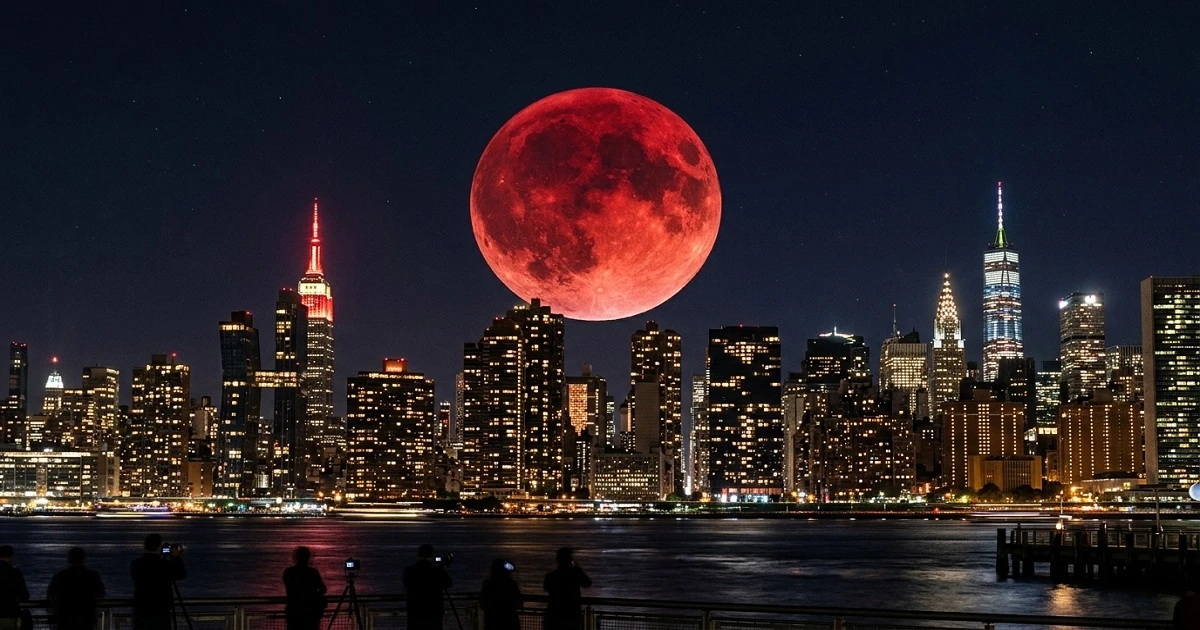

A total lunar eclipse turned the full moon a deep, coppery red in the early hours of March 3, 2026, treating millions of Americans to one of the year’s most striking sky events.
UNITED STATES — Millions of early risers and late-night sky watchers across the country looked up before dawn Tuesday to find the moon glowing a vivid shade of red — the result of a total lunar eclipse that swept across North America overnight.
The event, widely known as the blood moon, peaked at approximately 6:26 AM Eastern Time, with the moon spending nearly an hour bathed in Earth’s shadow before slowly returning to its normal colour. On the West Coast, the peak came at 3:26 AM Pacific Time, giving California and the Pacific Northwest one of the most accessible viewing windows in years.
Clear skies across much of the country made for ideal conditions, and social media quickly filled with photos and videos of the red moon hanging low over city skylines, open fields, and suburban rooftops.
What Happened in the Sky
Tuesday’s event was a total lunar eclipse — a phenomenon that occurs when Earth lines up precisely between the Sun and a full moon, casting its shadow across the lunar surface.
During totality, direct sunlight no longer reaches the moon. Instead, light that passes through Earth’s atmosphere bends around the edges of the planet. Blue wavelengths scatter away, leaving the longer red and orange wavelengths to fall on the moon’s surface — turning it the deep crimson colour that has given the blood moon its name.
Totality began at 6:04 AM Eastern and lasted approximately 59 minutes, giving viewers on the East Coast a narrow but spectacular window before sunrise washed out the sky. West Coast viewers saw the full event in the middle of the night, well before any hint of morning light.
The partial eclipse — when Earth’s shadow first begins creeping across the moon — started as early as 4:50 AM Eastern, giving attentive observers an early sign of what was coming.
Who Saw It and Where
The lunar eclipse was visible across most of the United States, though the experience varied depending on location and local weather.
East Coast cities, including Miami, Atlanta, New York, and Boston, had a direct but time-sensitive view, with totality ending just as sunrise approached. Midwest viewers in Chicago, St. Louis, and Detroit caught the full blood moon in the pre-dawn darkness. Across the South — Texas, Louisiana, and the Gulf Coast — conditions were favourable throughout the event.
In the Mountain West, cities including Denver and Phoenix saw totality in the middle of the night, between roughly 4 and 5 AM local time. California had perhaps the most comfortable experience of any major US region — the peak blood moon arrived around 3:26 AM Pacific, squarely in the middle of the night, with no race against sunrise.
The eclipse was also visible across much of Canada, Mexico, parts of South America, Western Europe, West Africa, and sections of East Asia and Australia.
No Equipment Needed
Unlike a solar eclipse, which requires certified protective eyewear, a lunar eclipse is completely safe to watch with the naked eye. No telescope, no glasses, no special equipment required.
Astronomers and hobbyists alike recommend finding a dark location away from heavy light pollution and giving your eyes at least 15 minutes to adjust before totality begins. Binoculars and small telescopes can sharpen the detail on the moon’s surface during the red phase, but they are far from necessary.
The Griffith Observatory in Los Angeles, one of the most visited public astronomy venues in the country, offered public viewing and a livestream for those in cloudy or light-polluted areas.
Why March 3 Matters
The March full moon carries a traditional name — the Worm Moon — a reference to the earthworms that begin to surface as the frozen ground thaws in late winter. Tuesday’s Worm Moon was also a blood moon, a combination that drew extra attention from casual viewers and astronomy enthusiasts alike.
Total lunar eclipses are not rare in the broad sense, but they are infrequent enough that missing one means waiting. On average, a total lunar eclipse occurs somewhere on Earth roughly every 1.5 years. Whether one is visible from any specific location depends on timing and geography.
What Comes Next
For those who missed Tuesday’s event — whether due to cloud cover, geography, or a deep sleep — the next total lunar eclipse visible from North America is expected within the next two to three years. NASA maintains a public eclipse calendar that lists confirmed dates well in advance.
The next full moon after Tuesday’s blood moon will arrive in early April, though without the drama of an eclipse.
Tuesday’s event was a reminder that some of the most extraordinary things in the natural world require nothing more than clear skies, an alarm clock, and a willingness to step outside and look up.
