
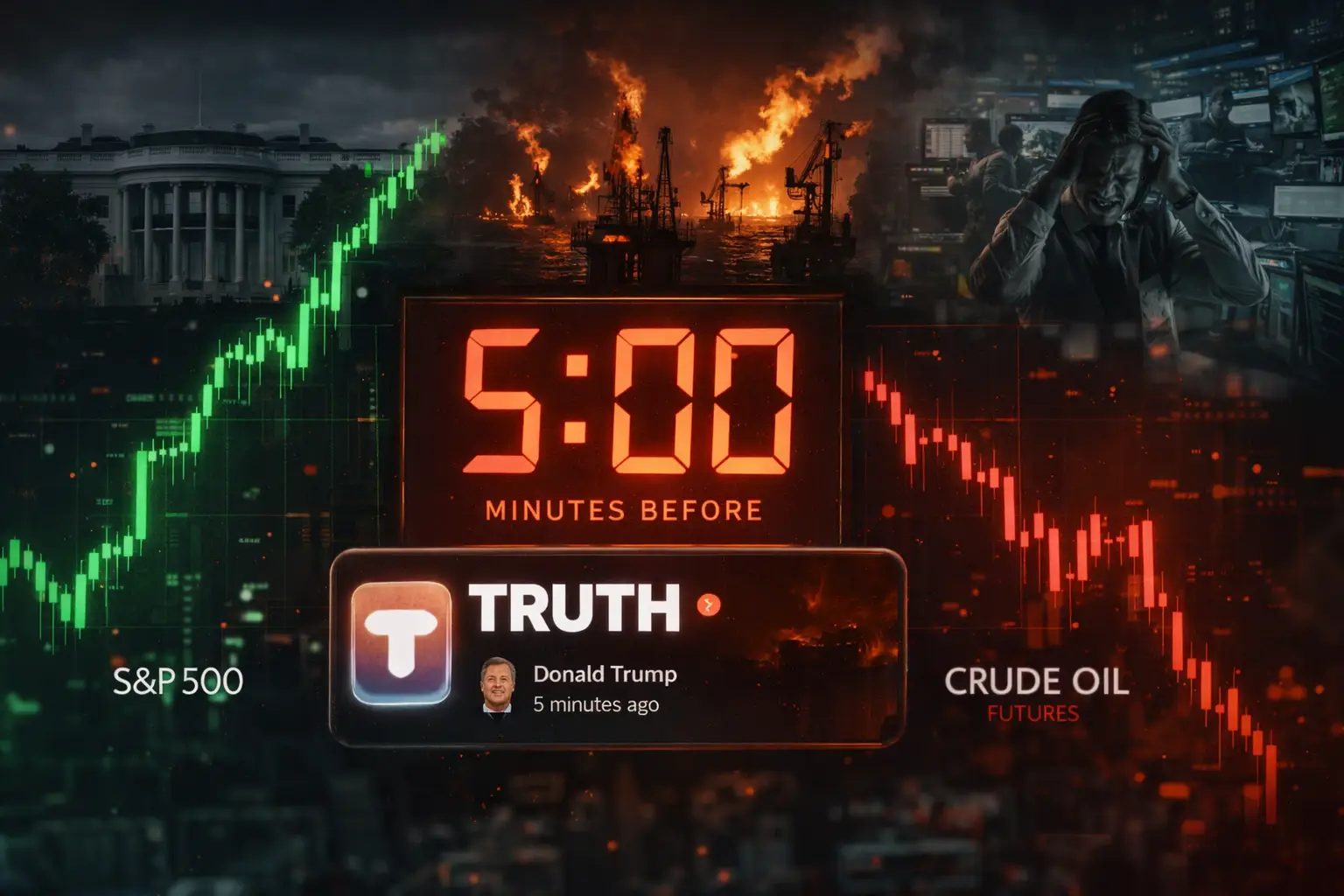

Wall Street had another wild Monday, but the real drama may have unfolded before the opening bell. On March 23, President Donald Trump posted on Truth Social that the U.S. would pause planned military strikes on Iranian power plants and energy infrastructure for five days. He cited “very good and productive conversations” with Tehran about resolving hostilities in the Middle East. Iran quickly denied that any such talks were taking place, but the markets didn’t wait for clarification. Stocks surged. Oil plunged.
And according to traders and market observers, someone appears to have known exactly what was coming.
The Trades That Raised Eyebrows
Just five minutes before Trump’s announcement hit social media around 7:05 a.m. ET, an unusually large burst of activity lit up the futures markets during the quiet Asian trading hours.
- Roughly $1.5 billion in S&P 500 e-mini futures (ES) were bought in a single aggressive move.
- At the same time, approximately $192 million in crude oil futures (CL) were sold.
These orders were reported to be 4–6 times larger than typical volume at that time of day, according to multiple market participants tracking the tape.
cnbc.comWhen Trump’s post dropped, S&P 500 futures immediately jumped more than 2.5%. By the end of the session, the S&P 500 had closed up around 1.1–1.7%—its best day since the conflict intensified. Meanwhile, West Texas Intermediate crude fell over 10% to settle near $88 per barrel, and Brent crude dropped nearly 11% to just under $100.
The timing has left many asking the obvious question: Was this pure coincidence, or did someone with early access to the president’s decision front-run the news?
Markets React Sharply to De-Escalation Signal
The move came after days of escalating tensions. Trump had previously issued a 48-hour ultimatum to Iran to fully reopen the Strait of Hormuz or face strikes on energy targets. Oil prices had spiked above $110–$120 amid fears of broader disruption to global supply routes. Trump’s sudden pivot to “productive talks” reversed the sentiment almost instantly. Risk assets rallied while safe-haven oil collapsed. Gold also saw volatility but ultimately settled higher as uncertainty lingered. Iran’s foreign ministry and other officials dismissed the claims of negotiations as “fake news,” adding another layer of confusion. Israeli strikes on Iranian infrastructure continued even as the U.S. signaled a pause, keeping the situation fluid.
Not the First Time
This isn’t the first instance of unusually well-timed trades ahead of major Trump administration announcements. Observers have pointed to similar patterns around tariff decisions, policy reversals, and other market-moving statements in recent months.
Critics on social media and in trading circles were quick to draw parallels to historical anomalies, such as the heavy put buying in airlines before 9/11—though those cases remain debated and largely unresolved.In this case, the sheer size of the positions—placed in thin overnight liquidity—makes the episode stand out. A $1.5 billion long on equities and a corresponding short on oil right before a de-escalation headline is the kind of bet most traders would only make with extremely high conviction… or very specific information.
What Happens Next?
The SEC and CFTC have not publicly commented on the trades as of this writing. Under normal circumstances, such outsized activity in futures would trigger at least a review for potential insider trading or market manipulation, especially when linked to government announcements.
For now, the five-day pause gives negotiators breathing room. Markets will likely remain on edge, swinging on every headline out of Washington, Tehran, or Jerusalem.
Investors should stay cautious. Geopolitical events have a habit of reversing course quickly, and today’s winners could easily become tomorrow’s losers if talks break down.
One thing is clear: When billions can be made or lost on a single presidential post, the line between policy, politics, and profit becomes dangerously blurred.
What do you think—coincidence, smart positioning, or something more? Drop your thoughts in the comments. Stay tuned to Finexnews.com for continuing coverage of markets, geopolitics, and the forces moving your portfolio.
