
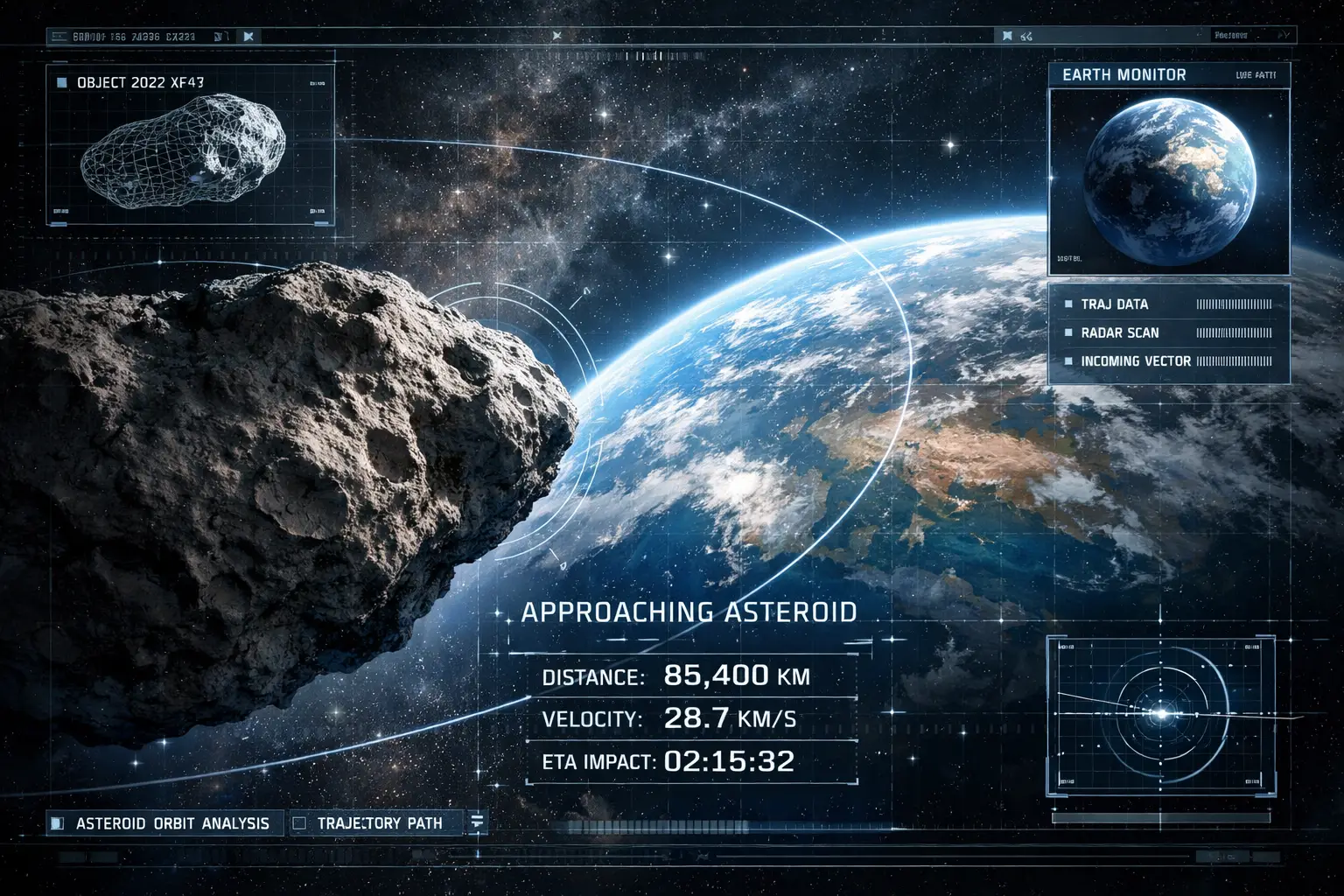

WASHINGTON — NASA scientists are closely monitoring an asteroid approaching Earth, a bus-sized space rock expected to pass our planet in a relatively close — but safe — flyby this week.
The asteroid, officially labeled 2026 EG1, is traveling through the inner solar system at more than 21,500 miles per hour, according to tracking data from NASA’s Center for Near-Earth Object Studies (CNEOS).
Astronomers estimate the asteroid measures about 40 feet in diameter, roughly the size of a city bus. It is projected to make its closest approach to Earth tomorrow, passing within about 198,000 miles of the planet — closer than the average distance between Earth and the moon.
Despite the relatively close distance, NASA scientists emphasize that the asteroid approaching Earth poses no threat of impact.
Close Pass but No Danger to Earth
NASA regularly tracks thousands of objects moving through Earth’s orbital neighborhood. Most of these are known as near-Earth objects, or NEOs — asteroids and comets whose paths bring them near our planet’s orbit.
While the upcoming flyby of 2026 EG1 may sound dramatic, astronomers say it falls within the range of routine cosmic events that occur throughout the year.
The space rock will pass well outside Earth’s atmosphere, and its trajectory shows no risk of collision, according to NASA’s orbital calculations.
For comparison, the moon orbits Earth at an average distance of roughly 239,000 miles, meaning the asteroid’s closest approach will still occur at a significant distance in space.
Why NASA Tracks Asteroids Approaching Earth
Tracking an asteroid approaching Earth is part of NASA’s planetary defense effort. The agency monitors thousands of near-Earth objects to determine whether any could pose a future hazard.
Most asteroids originate from the main asteroid belt between Mars and Jupiter, leftover fragments from the formation of the solar system more than 4.6 billion years ago.
Occasionally, gravitational forces shift their orbits, sending them into the inner solar system and closer to Earth’s path around the sun.
Objects considered “potentially hazardous asteroids” are those large enough and close enough to require additional observation. However, scientists say none currently tracked are expected to strike Earth anytime soon.
Asteroid Discoveries Increasing
Advances in telescopes and sky-survey technology have dramatically increased the number of asteroids discovered each year.
Recent monitoring programs have identified thousands of new objects, many of which are small rocks only a few dozen feet wide. These often pass near Earth without ever entering the atmosphere.
NASA and international observatories continue scanning the skies daily to ensure that any future asteroid approaching Earth is detected well in advance.
For now, the upcoming flyby of asteroid 2026 EG1 offers astronomers another opportunity to study near-Earth objects as they pass through our cosmic neighborhood.
