
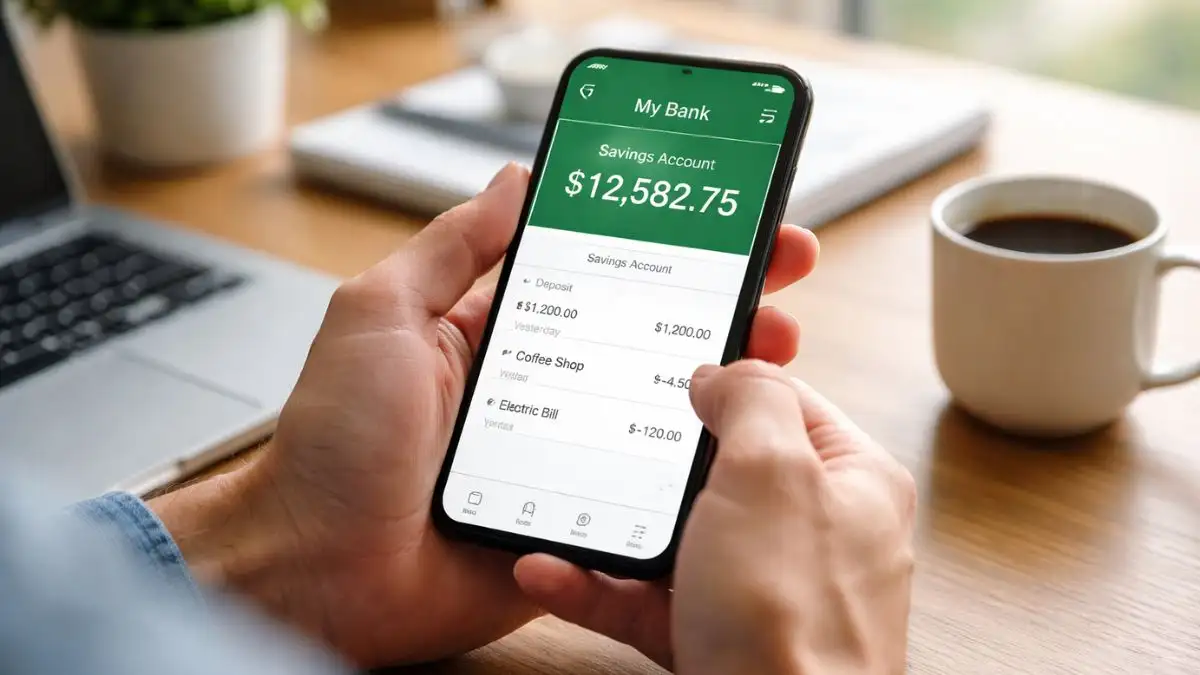

The best savings account in the country right now pays 5.00% APY. The average savings account at a big bank pays 0.01%. That gap costs millions of Americans hundreds — sometimes thousands — of dollars every year for doing absolutely nothing differently.
If your savings are sitting at Chase, Bank of America, or Wells Fargo, you’re almost certainly leaving serious money on the table. Here’s what’s actually available right now and how to pick the right account for your situation.
Top High-Yield Savings Account Rates — April 2026
Every rate below was verified on April 7, 2026. These are nationally available accounts, ranked by APY.
| Institution | APY | Min. Opening Deposit | Min. Balance | Key Requirements |
|---|---|---|---|---|
| Varo Bank | 5.00% | None | None | Direct deposits; APY on balances up to $5,000 |
| AdelFi | 5.00% | $100 | None | Credit union membership; APY on balances up to $5,000 |
| Pibank | 4.60% | None | None | Mobile app only; wire/Plaid deposits only |
| Fitness Bank | 4.50% | $100 | $100 | Checking account + 10,000 daily steps |
| CineFi | 4.25% | None | None | Credit union membership |
| Abound Credit Union | 4.25% | None | None | Credit union membership; APY on balances up to $5,000 |
| OnPath Credit Union | 4.25% | $25,000 | $25,000 | New money; 3 fee-free withdrawals/month |
| Axos Bank | 4.21% | None | $1,500 | Direct deposits |
| Newtek Bank | 4.20% | None | None | None |
| TIMBR | 4.15% | $1,000 | None | ACH transfers only |
| CIT Bank | 4.10%* | $100 | $5,000 | Promo code CITBOOST |
| MutualOne Bank | 4.07% | $20,000 | $20,000 | New money only |
| OMB Bank | 4.05% | $5,000 | None | Electronic statements |
| Vio Bank | 4.03% | $100 | None | None |
| Climate First Bank | 4.01% | $50 | None | None |
| TotalBank | 4.01% | $25,000 | $2,500 | Not available to Florida residents |
*CIT Bank base APY is 3.75%; the additional 0.35% applies for the first 6 months on balances of at least $5,000 when you open with promo code CITBOOST.
The Top Picks, Broken Down
Varo Bank — 5.00% APY
Varo is a fintech company that became a fully FDIC-insured bank in 2020 — one of the first fintechs to do so. To earn 5.00%, you need at least $1,000 in monthly qualifying direct deposits, an open Varo checking account, and a positive balance across all your Varo accounts at month’s end.
The catch: the 5.00% rate only applies to balances up to $5,000. Anything above that earns 2.50% — and if you miss the monthly requirements, the entire balance drops to 2.50%. For someone using Varo as their primary bank with direct deposit, this account is hard to beat.
AdelFi — 5.00% APY
AdelFi is the digital banking brand of Christian Community Credit Union, which dates to 1984. Membership requires agreeing to AdelFi’s statement of faith — this is a faith-based institution, so that’s a meaningful qualifier. The 5.00% APY is only available to new members and applies to balances up to $5,000. Balances between $5,001 and $10,000 earn 2.25%, and anything above $10,000 earns just 0.35%.
If you qualify for membership and keep your savings balance under $5,000, this is a legitimate 5.00% option with a $100 minimum opening deposit.
Pibank — 4.60% APY
Pibank is operated by Intercredit Bank, a Miami institution established in 1992 that launched its U.S. app product in 2024. At 4.60%, it offers the third-highest rate on the list with no minimum balance requirement — but the limitations are significant. No ACH transfers, no check deposits, no direct deposits, and no desktop access. You fund it via wire transfer or Plaid. For some people, that’s a dealbreaker. For others, it’s just a dedicated high-rate holding account.
Fitness Bank — 4.50% APY
This one is unusual. Fitness Bank ties its top savings rate to your daily step count — specifically, 10,000 steps per day tracked through the bank’s app. You also need to open an Elite Checking account and maintain a $5,000 average daily balance in that account. A division of Affinity Bank (established 1928), Fitness Bank is legitimate and FDIC-insured. If you’re already hitting 10,000 steps most days and want to link your healthy habits to a financial reward, the 4.50% rate is genuinely competitive.
Newtek Bank — 4.20% APY
No hoops to jump through here. Newtek Bank’s Personal High Yield Savings account requires no minimum balance, no minimum opening deposit, and has no monthly fee. The only limitation: no ATM card and no mobile check deposit. Newtek rebranded in 2023 and operates nationally online, FDIC-insured since 1963 as National Bank of New York City. If simplicity matters to you, this is one of the cleanest options on the list.
Vio Bank — 4.03% APY
Vio Bank is the online arm of MidFirst Bank, an Oklahoma bank founded in 1911 and one of the top 100 largest U.S. banks by assets. Vio requires just a $100 opening deposit with no ongoing minimum balance and no monthly fee. It doesn’t offer a checking account or ATM card, which makes it best suited as a dedicated savings vehicle rather than an everyday account. Clean, simple, and reliable.
What the Fed’s Decisions Mean for Your Rate Right Now
The Federal Reserve held its benchmark rate steady at 3.50%–3.75% at its March 18, 2026 meeting — the second consecutive meeting with no change, following six rate cuts between September 2024 and January 2025. High-yield savings rates track the federal funds rate closely, which means the rates available today could fall if the Fed cuts again later this year.
This matters for your strategy. A savings account rate is variable — unlike a CD, there’s no lock-in. If you want to guarantee a specific rate for 12 to 24 months, a CD is worth comparing. But if you need the flexibility to access your funds, the current savings rates are still strong.
How Much Can You Actually Earn?
The math here is straightforward, and the difference between a top-rate account and a big-bank account is striking. Based on a 5.00% APY versus the FDIC national average of 0.39% APY, here’s what one year of interest looks like:
| Balance | At 0.39% (national avg.) | At 5.00% (top rate) | Extra Earnings |
|---|---|---|---|
| $1,000 | $1,004 | $1,050 | +$46 |
| $5,000 | $5,019 | $5,250 | +$231 |
| $10,000 | $10,039 | $10,500 | +$461 |
| $20,000 | $20,078 | $21,000 | +$922 |
| $50,000 | $50,195 | $52,500 | +$2,305 |
| $100,000 | $100,390 | $105,000 | +$4,610 |
For someone with $20,000 in savings, the gap between the national average and the top rate is nearly $1,000 per year — money that comes entirely from choosing the right account.
What to Look For When Choosing an Account
APY — But Read the Fine Print
The rate listed is the rate you want, but check whether there are balance caps on the top APY. Several accounts on this list — including Varo, AdelFi, and Abound — only pay their highest rate on balances up to $5,000. If you’re depositing $30,000, you need an account without a cap, like Newtek or Vio.
Minimum Balance Requirements
Some accounts have two different minimums: one to open, and one to maintain. CIT Bank’s Platinum Savings, for example, requires $5,000 ongoing to earn the top rate. MutualOne Bank requires $20,000 to open and maintain. Don’t get caught by a minimum you can’t consistently meet — falling below it can mean a fee or a drastically lower rate.
Activity Requirements
Varo requires monthly direct deposits. Fitness Bank requires daily step counts. Axos requires qualifying deposits. If your paycheck doesn’t go to direct deposit at the new bank, or if you’re not willing to reroute it, make sure the account you pick doesn’t require it.
Access and Transfers
Most high-yield accounts are online-only, which means you move money in and out via ACH transfer — typically taking one to three business days. Plan your cash flow accordingly and keep enough in your primary checking account to cover short-term expenses. Pibank is more restrictive than most, accepting only wire transfers and Plaid. If you need flexible access, that’s a significant limitation.
FDIC or NCUA Insurance
Every account on this list is either FDIC-insured (banks) or NCUA-insured (credit unions), which protects up to $250,000 per depositor per institution. Don’t open a savings account — high-yield or otherwise — without confirming this coverage.
Why Big Banks Pay So Little
Chase, Bank of America, and Wells Fargo all pay approximately 0.01% APY on standard savings accounts. That’s not a rounding error — it’s a deliberate business decision. These banks have massive, loyal deposit bases and don’t need to compete for your money. They generate deposits through brand recognition, branch networks, and bundled checking accounts.
Online-only banks and smaller regional institutions don’t have that advantage. They attract deposits by offering better rates. The tradeoff for you is less brand recognition and no physical branches — but your money is just as safe as long as the FDIC or NCUA backs it.
High-Yield Savings vs. Other Cash Options
High-Yield Savings vs. Certificates of Deposit (CDs)
A CD locks your money in for a fixed term — typically three months to five years — and guarantees a fixed rate. If the Fed cuts rates, your CD rate stays the same. The risk: if you pull money out early, you’ll pay a penalty, usually several months of interest.
The current CD environment is worth comparing directly. If you don’t need access to some portion of your savings for 12 or 24 months, a CD might lock in a rate that a high-yield savings account could lose if rates fall further.
High-Yield Savings vs. Money Market Accounts
Money market accounts work almost identically to savings accounts in practice, despite the different name. Some offer check-writing privileges; most of the accounts on competitive rate lists don’t. TotalBank and OnPath Credit Union both use “money market” in their names but don’t offer check writing — they function like standard savings accounts. Compare rates between both categories before deciding.
High-Yield Savings vs. Rewards Checking Accounts
Some checking accounts offer competitive rates — typically 3% to 5% APY — but require significant monthly activity like 10 to 15 debit card transactions and a direct deposit. If you’re a heavy debit card user, this could work. But the requirements are often more demanding than a high-yield savings account, and the qualifying balance caps are frequently lower.
How to Open a High-Yield Savings Account
The process is entirely online for every account on this list and typically takes 10 to 15 minutes. You’ll need:
- Your Social Security number (required — interest income is reported to the IRS on a 1099-INT)
- A government-issued photo ID
- Your current bank’s routing and account number to fund the new account via ACH transfer
Some institutions let you fund the account immediately with a debit card. Others require a mailed check or an ACH transfer that takes one to three business days. Once your account is open, set up an automatic monthly transfer from your checking account — even $100 or $200 per month compounds meaningfully over time.
The Bottom Line
The best high-yield savings account rate available right now is 5.00% APY — more than 12 times what the average American earns on their savings. Getting there doesn’t require moving all your money or closing your existing accounts. It means opening one additional account at an institution that competes for your deposits.
If you want maximum simplicity with no requirements, Newtek Bank at 4.20% or Vio Bank at 4.03% are the cleanest choices. If you’re willing to set up direct deposit and keep a balance under $5,000, Varo at 5.00% is the best rate on the market right now.
Your next step: Pick one account from this list that matches your balance and requirements, open it online today, and set up an automatic monthly transfer. You’ll start earning more on money you already have — without changing anything else about how you manage your finances.
