
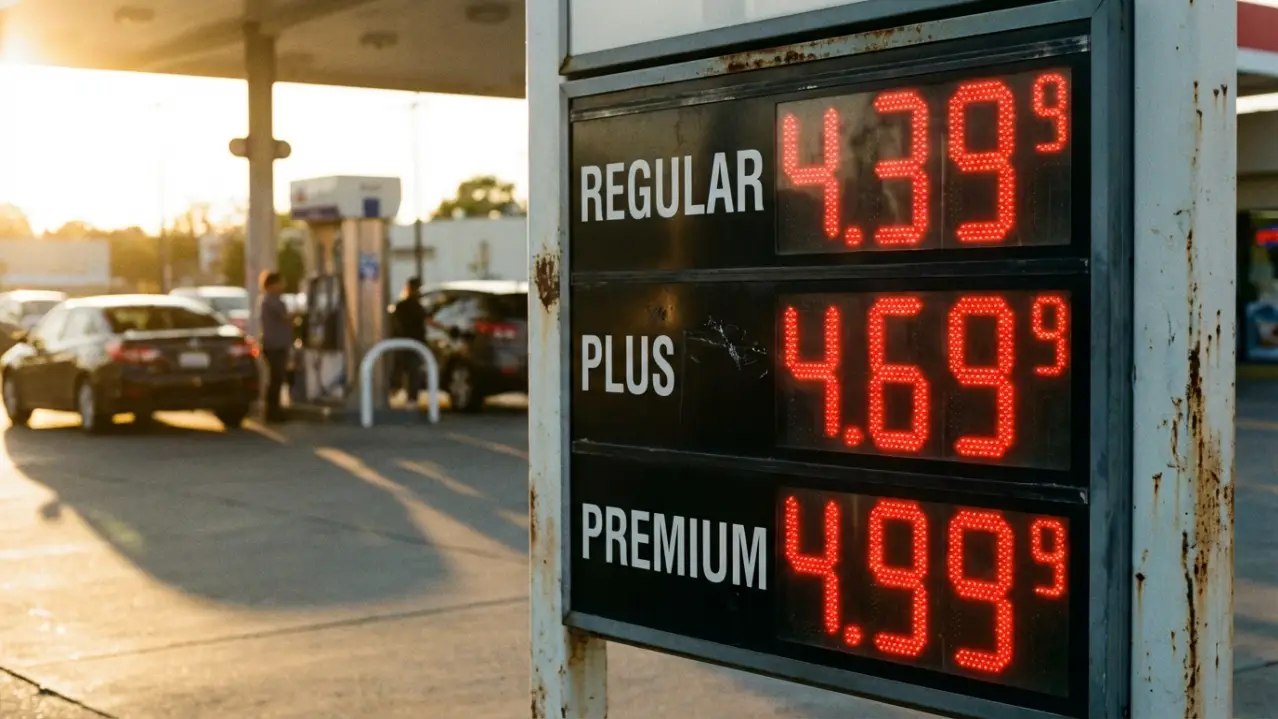

Gas crossed $4 a gallon nationally for the first time since 2022 — and it happened in a single month. Here’s what’s driving the surge, what you’re paying right now in your state, and how much worse it could get.
The Iran War Is the Engine Behind Every Cent of This Increase
Gas prices have soared more than 30% since the U.S. and Israel attacked Iran in late February, according to AAA. Prices at the pump hit a nationwide average of $4.018 — the highest level since August 2022, when Russia’s war against Ukraine shook energy markets.
Before the war started, the national average sat at $2.98 a gallon on February 26. A month later, it had cleared $4. That surge marked the fastest monthly increase dating back to October 1990, according to Macquarie Group head of economics David Doyle.
The mechanism is direct. The Strait of Hormuz — the waterway that carries a fifth of the world’s crude oil and liquefied natural gas — has been effectively closed since early March. Fuel prices account for 50% to 60% of the total operating cost of shipping goods by sea, according to Patrick Penfield, professor of supply chain practice at Syracuse University. “When fuel prices start to go up, everything starts to slow down,” Penfield said.
The International Energy Agency described the situation caused by the war as the “greatest global energy security challenge in history.” Brent crude oil surged more than 40% since the conflict began, reaching above $100 per barrel.
What You’re Paying at the Pump: Gas Prices by State (March 31, 2026)
Prices have surged everywhere, but the variation from state to state is striking. The gap between the cheapest and most expensive states now sits at $2.62 per gallon — a difference that adds up to more than $52 every time you fill a 20-gallon tank.
Most Expensive States
| State | Average Price/Gallon |
|---|---|
| California | $5.89 |
| Hawaii | $5.45 |
| Washington | ~$5.00+ |
| Oregon | Above $4.00 |
| Nevada | Above $4.00 |
| Arizona | Above $4.00 |
| Illinois | Above $4.00 |
Least Expensive States
| State | Average Price/Gallon |
|---|---|
| Oklahoma | $3.27 |
| Iowa | ~$3.30s |
| Kansas | ~$3.30s |
| Nebraska | ~$3.30s |
| South Dakota | ~$3.30s |
Source: AAA, as of March 31, 2026
The AAA national average stood at $4.018 as of March 31, 2026, with state prices ranging from the $5.887–$4.199 tier down to $3.624–$3.272 at the lower end. Every state in the country now averages more than $3.25 per gallon. Before the war, several states were comfortably below $3.
Diesel:
The gasoline price is the number everyone talks about. The diesel number is the one that will ripple through your grocery bill, your Amazon orders, and every physical product you buy.
Diesel prices hit $5.45 per gallon on Tuesday — up 45% since the start of the war, according to AAA. Diesel crossed the $5 mark on March 17.
A 10% rise in diesel could push up the headline consumer price index by 0.1%, according to Joe Brusuelas, chief economist at RSM US, citing Bloomberg research. Since diesel has risen more than 40%, the math points toward a meaningful inflation push in the coming weeks.
Consumers could see the impact by April through higher prices at the supermarket and for their online orders, said Patrick De Haan, head of petroleum analysis at GasBuddy. “This is really quickly going to ignite additional inflation,” De Haan said.
It’s not abstract. Every truck that delivers groceries, every ship that carries imports, and every piece of farm equipment that plants crops runs on diesel. When that fuel costs 45% more than it did five weeks ago, the cost eventually lands at checkout.
The Real Cost to American Households
Gas prices aren’t just an inconvenience. At current levels, they’re a meaningful financial event for most families.
The average U.S. household will spend an additional $740 on gas this year because of the jump in oil prices, according to economists from the Stanford Institute for Economic Policy Research. That figure is roughly double the $360 average boost to individual households’ federal tax refunds from recent tax law changes — meaning the gas price shock effectively erases this year’s tax refund and then some for many families.
Mark Zandi, chief economist at Moody’s, put it plainly: “This is especially hard on lower- and middle-income households, who have little or no financial resources, and so if they need to put more of their earnings in their gas tank, they have to cut other spending or pay on their credit cards and other debts more slowly. Higher gasoline prices act like a regressive tax, as lower-income households devote a higher share of their budget to energy.”
U.S. households pay on average $2,500 a year — or nearly $50 a week — to fill up their tank, according to Mark Mathews, chief economist at the National Retail Federation. At current prices, many households are paying $10 or more extra per week. “How do they offset that?” Mathews said. “Going out to a movie theater or going to a theme park or going out to eat — all those areas would be more likely to see cuts.”
The economic structure of this kind of shock is well-understood: consumer spending accounts for roughly 70% of U.S. GDP. When households spend more at the pump, they spend less everywhere else.
Why Gas Prices Vary So Dramatically From State to State
The difference between Oklahoma’s $3.27 and California’s $5.89 doesn’t come from one thing. It comes from a stack of structural factors that compound on each other.
Taxes and fees. Federal and state taxes accounted for more than 14% of the average price per gallon in 2023, according to the U.S. Energy Information Administration. California levies some of the highest gasoline taxes in the country. Oklahoma levies some of the lowest. When the base price of oil spikes, high-tax states start from a higher floor — so their prices end up higher in absolute terms even with the same percentage increase.
Refinery access and geography. States in the Gulf Coast and Midwest sit near major refineries and established pipeline infrastructure, which keeps transportation costs low. California relies on imports of gasoline and other refined products from Asia because some of its refineries have shut down in recent years. That dependency on international supply chains makes California uniquely exposed when global energy markets are disrupted.
Boutique fuel requirements. California mandates a special blend of gasoline that relatively few refineries produce. The state’s mandate for a special blend, a lack of petroleum infrastructure connections, and high gas taxes all contribute to higher fuel costs, according to GasBuddy. When crude prices spike, the limited supply of compliant California-grade fuel gets bid up sharply — amplifying the national trend into something much more severe.
The Iran war amplifier. When oil prices rise sharply because of geopolitical disruption, these built-in cost structures don’t disappear — they multiply. A state like California that already paid a premium now pays a larger absolute dollar premium. A state like Oklahoma that benefits from proximity to domestic production gets partial insulation. The spread between the two widens.
What the Government Is Doing — and What It Can’t
Trump ordered the Department of Energy to release 172 million barrels from the Strategic Petroleum Reserve in early March, which would take around 120 days to deliver.The release is significant in scale, but the timing gap is real — 120 days is four months, well past when most of the price damage will already be done.
The EPA temporarily waived restrictions on the sale of E15 gas — a fuel blend containing 15% ethanol that’s normally restricted in about half the U.S. during summer months due to air pollution rules. The waiver takes effect May 1 and lasts through May 20, with possible extension. The EPA said it will monitor supply with industry and federal partners.
Both moves may provide marginal relief. Neither addresses the root cause. Oil needs to start moving through the Strait of Hormuz again for prices to ease, analysts say. “The president doesn’t have a whole lot of levers,” De Haan said.
How Much Higher Could Gas Get? The Forecasts
In its March 2026 short-term outlook, the EIA projected Brent crude oil prices would remain above $95 per barrel for the next two months before falling below $80 in Q3 2026, ending the year around $70. The EIA also said crude oil prices could push retail gas prices roughly 60 cents per gallon higher in March and about 70 cents higher in Q2 2026, before falling back toward $3 by year-end — but those projections rest on assumptions that shut-in oil production peaks in early April and Strait of Hormuz transit resumes.
Those assumptions are far from guaranteed. Daily traffic through the Strait of Hormuz has fallen from over 100 vessels per day before the conflict to fewer than five ships, according to data from the International Monetary Fund.
PNC Economics forecasts an increase of about $1 per gallon for each additional month the disruption persists. If the Strait stays effectively closed through May, the national average could approach $5. If it reopens quickly, the EIA’s lower-path forecast becomes more credible and prices could start easing by summer.
What the Last Time We Saw $5 Gas Can Teach Us
The national average briefly topped $5 per gallon in June 2022 following Russia’s invasion of Ukraine. That spike took roughly four months to build and another four to substantially unwind. Demand destruction — people driving less, buying more fuel-efficient vehicles, and cutting discretionary travel — played a meaningful role in bringing prices down.
The 2026 situation differs in two key ways. The supply disruption is more concentrated: the Strait of Hormuz blockade is a physical chokepoint, not a sanctions-driven rerouting that can partially work around. And inflation was already elevated before the war began, meaning the Federal Reserve has less room to accommodate additional price pressure without damaging economic credibility.
Economist Gregory Daco of EY-Parthenon estimated that the bump in gas prices could push monthly inflation to as high as 1% in March, which would be the highest monthly increase in four years, with annual inflation nearing 3%.
Practical Steps to Reduce Your Fuel Costs Right Now
You can’t control crude oil prices. You can control how much you pay for the crude oil that’s already been refined and sitting at the station down the street.
Shop around. Gas prices can vary by 20 to 30 cents per gallon within a few miles of each other, especially in urban areas. Apps like GasBuddy, Waze, and Google Maps show live prices at nearby stations.
Use a gas rewards credit card. Grocery store chains and dedicated gas station cards routinely offer 3 to 5 cents off per gallon, or 2% to 5% cash back on fuel purchases. On a month where you’re spending $80 to fill up, that discount adds up across the year.
Optimize your driving. Aggressive acceleration and braking can reduce fuel efficiency by 15% to 30% on the highway, according to the U.S. Department of Energy. Maintaining consistent speeds, especially on highways, is the single easiest no-cost improvement.
Check tire pressure. Under-inflated tires increase rolling resistance and reduce fuel economy. The DOE estimates that keeping tires properly inflated can improve gas mileage by 0.5% to 3%.
Consider E15 when the EPA waiver takes effect May 1. E15 — a blend of 15% ethanol and 85% gasoline — typically costs 3 to 10 cents less per gallon than standard E10. Most vehicles made after 2001 can use it. The temporary EPA waiver through at least May 20 means stations can sell it year-round through that window.
The Bottom Line
Gas prices have soared more than 30% in five weeks. The average household is on track to spend $740 more this year at the pump — wiping out the financial benefit of recent tax cuts for most families. And the diesel surge hasn’t fully hit grocery shelves yet.
The trajectory from here depends almost entirely on whether the Strait of Hormuz reopens. If it does, prices could begin easing by summer. If it doesn’t, PNC Economics’ estimate of another dollar per gallon per month of disruption becomes the working forecast.
Your next step: Download GasBuddy or check GasPrices.AAA.com before your next fill-up. In a market where prices vary 30 cents per gallon within a few miles and are changing by the day, a two-minute comparison on your phone can save real money on every tank.
