
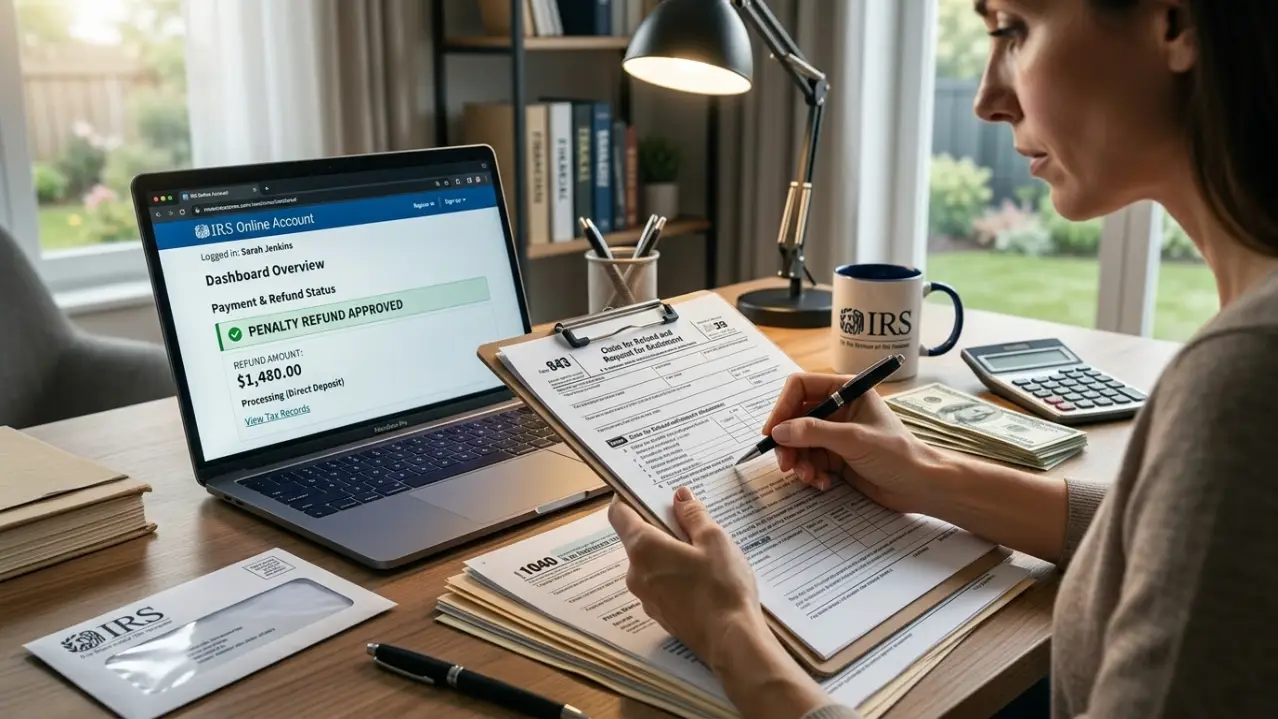

Millions of Americans who paid tax penalties during the COVID-19 disruption may still be able to get their money back. The IRS pandemic penalty refund opportunity has gained attention after legal interpretations suggested some penalties charged during the federal emergency period may have been assessed too early.
For taxpayers who paid late-filing or late-payment penalties during the pandemic, filing a refund claim could mean recovering hundreds or even thousands of dollars.
This guide explains who qualifies, how to check your IRS records, and the exact steps to file a claim before the deadline.
Who Qualifies for the IRS Pandemic Penalty Refund
Not every taxpayer will qualify, but several groups may be eligible for an IRS refund for pandemic tax penalties.
You may qualify if you:
- Paid IRS late filing penalties during the COVID-19 emergency period
- Were charged failure-to-pay penalties on federal income taxes
- Paid penalties between January 2020 and July 2023
- Filed tax returns late due to pandemic disruptions
- Paid penalties for 2019, 2020, or 2021 tax returns
Some taxpayers may already have received automatic relief from the IRS, but many others still need to file a claim manually to recover their money.
Step 1: Check Your IRS Account Transcript
Before filing a claim, you need to confirm whether the IRS charged penalties on your account.
How to check your transcript
- Visit the official Internal Revenue Service (IRS) website
- Sign in to your IRS Online Account
- Download your Account Transcript
- Look for entries labeled:
- Failure-to-file penalty
- Failure-to-pay penalty
- Interest on penalties
These entries show when the penalty was assessed and how much you paid.
If the penalty occurred during the pandemic emergency window, you may qualify for a refund.
Step 2: Confirm the Penalty Payment Date
Refund claims typically depend on when the penalty was paid, not just when it was assessed.
Check your transcript or bank records for:
- The date the penalty was paid
- The tax year involved
- Any interest charged by the IRS
This information will be needed when filing your claim.
Step 3: File IRS Form 843
To request a refund of the IRS penalty, taxpayers usually need to file IRS Form 843.
What Form 843 is used for
This form allows taxpayers to request refunds for:
- Tax penalties
- Interest charges
- Certain employment taxe
Key details you must include
When filling out Form 843, provide:
- The tax year involved
- The type of penalty
- The amount paid
- A written explanation requesting pandemic-related penalty relief
Attach supporting documents, such as IRS notices or transcripts, that show the penalty.
Step 4: Submit the Claim to the IRS
After completing the form:
- Print and sign the form
- Attach any supporting documents
- Mail it to the IRS address listed in the form instructions
Refund reviews can take several months, depending on IRS processing times.
Step 5: Track the Status of Your Refund
After filing, you can monitor your account through the IRS online portal.
While the Where’s My Refund tool primarily works for tax refunds, the IRS account transcript will show whether the penalty refund has been approved or credited.
Common Mistakes That Delay IRS Refund Claims
Many refund claims are delayed because of simple errors. Avoid these common mistakes:
Filing the Wrong Form
Some taxpayers mistakenly file an amended return instead of Form 843.
Missing Explanation
Always include a clear written request for relief from pandemic-era penalties.
Incorrect Tax Year
Double-check the tax year connected to the penalty.
Missing Documentation
Attach copies of IRS notices or transcripts that prove the penalty was charged.
Important Deadline for the IRS Pandemic Penalty Refund
Tax refund claims must follow the IRS statute of limitations.
Generally, you must file a claim:
- Within three years of filing the tax return, or
- Within two years of paying the penalty, whichever is later.
Some tax experts warn that claims tied to pandemic-era penalties could expire around 2026, depending on the tax year.
Why You Should Check Your Eligibility Now
Many taxpayers ignored IRS penalties during the pandemic chaos and simply paid the penalties. If the current legal interpretation stands, millions of Americans may be eligible for refunds.
Checking your IRS transcript takes only a few minutes and could reveal money the government owes you.
For taxpayers who paid penalties during COVID-19 disruptions, filing a claim now may be the only chance to recover those payments before the deadline passes.
