
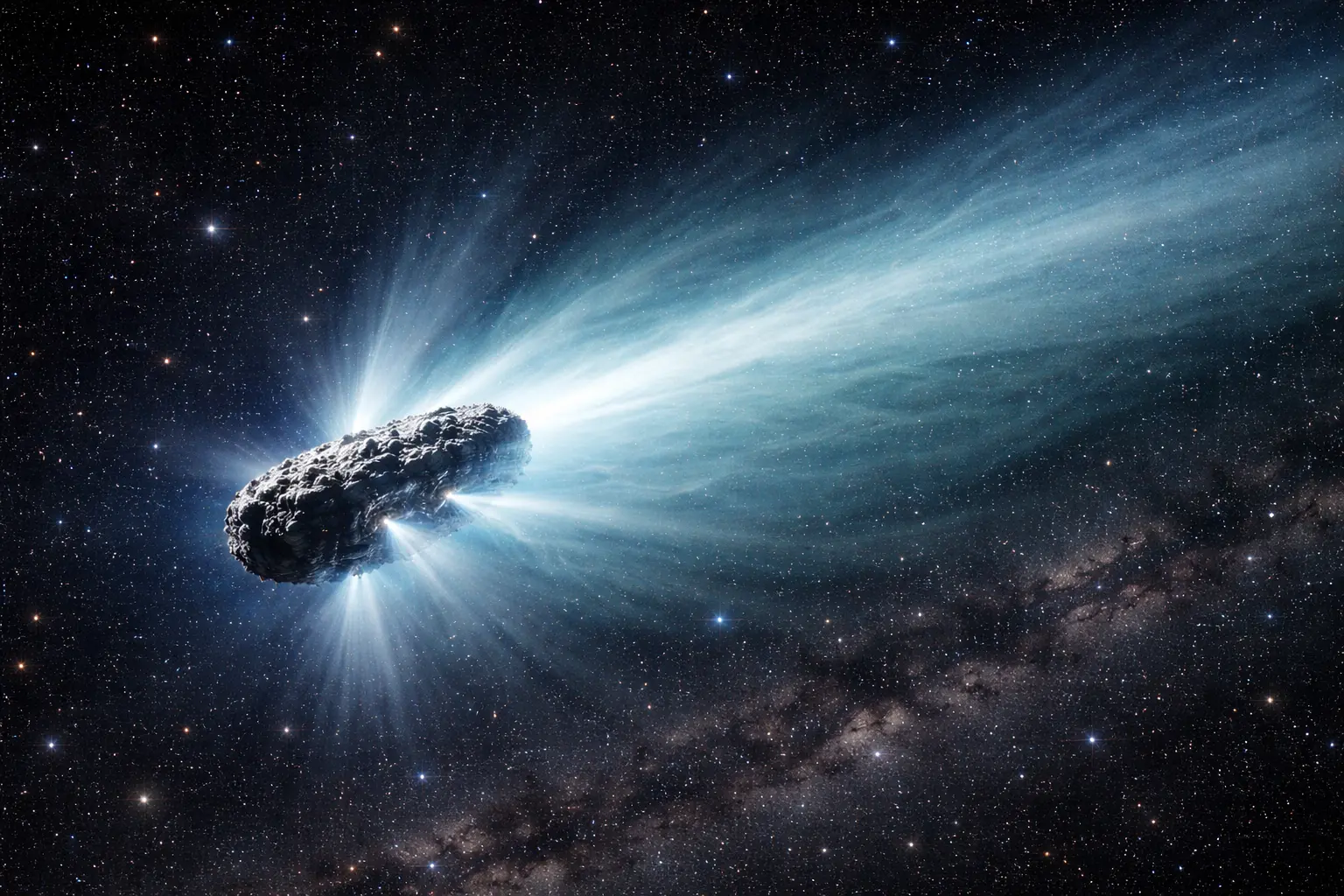

WASHINGTON – As the cosmic wanderer known as interstellar comet 3i atlas nasa continues its high-speed exit from our solar system, NASA has released a fresh batch of high-resolution images that are fundamentally changing what scientists know about visitors from beyond our sun.
Captured by a fleet of sophisticated observatories—including the Hubble Space Telescope and the European Space Agency’s JUICE probe—the latest visuals reveal a complex, dynamic world rather than the simple “blurry rock” some initially expected. These images provide the most detailed look yet at the third interstellar object ever detected in our cosmic neighborhood.
A New Look at a Galactic Traveler
The newly released data showcases an irregular, elongated nucleus and a dramatic flare-up in activity. While the comet made its closest approach to the sun in late October 2025, it has recently exhibited a surprising surge in brightness.
“We are seeing the pristine ices from deep within the comet finally warming up and erupting,” noted one NASA researcher. This “delayed venting” has created a massive coma—a halo of gas and dust—rich in carbon dioxide and water, offering a rare chemical fingerprint of the distant star system where the comet was born billions of years ago.
Current Location and Trajectory
As of March 2026, interstellar comet 3i atlas nasa is currently traversing the constellation Gemini. It is moving at a staggering 140,000 miles per hour, heading toward a significant flyby of Jupiter’s orbital path later this month.
Key facts about the current mission:
- Distance from Earth: Approximately 385 million miles and receding.
- Chemical Profile: High concentrations of nickel and carbon dioxide, setting it apart from typical “local” comets.
- Observation Window: While it is fading for amateur observers, NASA’s “Eyes on the Solar System” continues to track the object as it prepares to vanish back into the interstellar dark forever.
Unlike 1I/‘Oumuamua and 2I/Borisov, interstellar comet 3i atlas nasa has been monitored by more than 20 different space missions. This unprecedented “all-hands-on-deck” approach from NASA and its international partners has turned a chance discovery into a masterclass in interstellar chemistry.
Scientists believe the object acts as a time capsule, carrying materials that haven’t been exposed to solar radiation for eons. By studying the jets and wobbles of 3I/Atlas, astronomers are essentially peering into the history of a different sun, millions of light-years away.
