
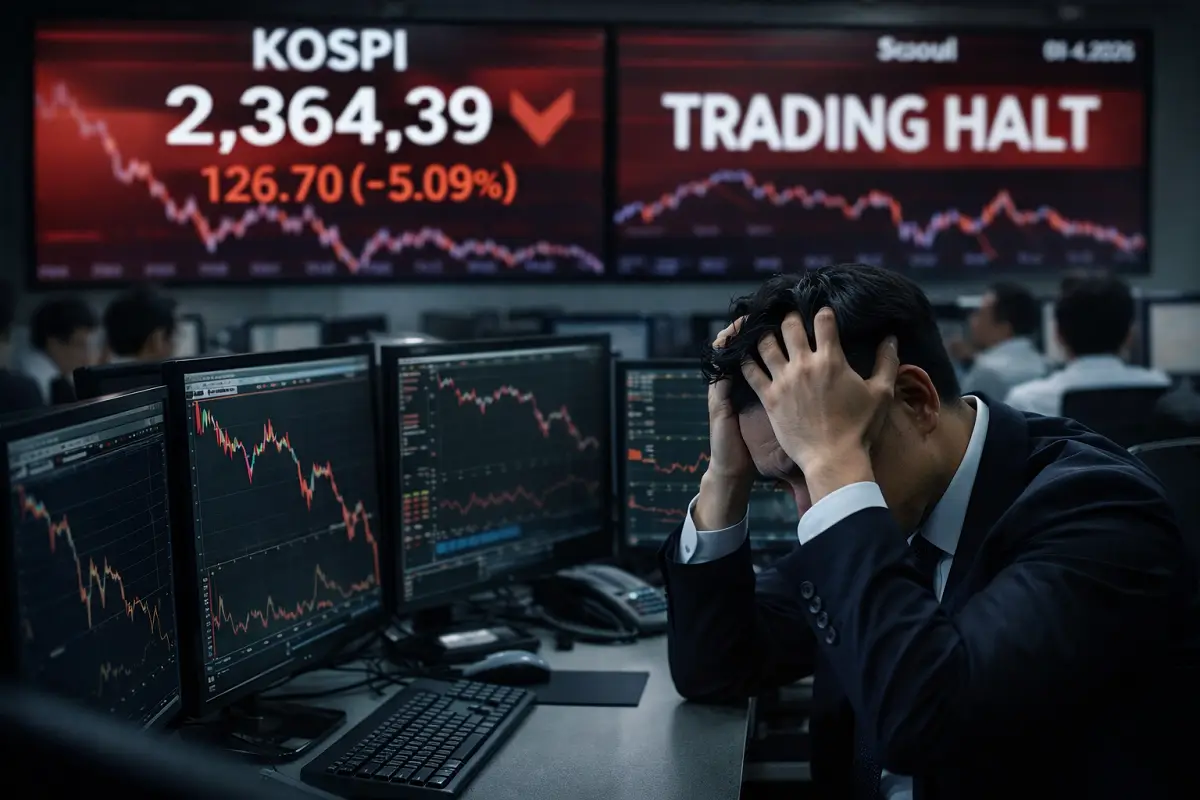

South Korea Stock Market Reels: KOSPI Plunges 11% as Middle East War Rattles Global Investors
SEOUL — The South Korean stock market, once the world’s top performer in early 2026, has entered a tailspin. On Wednesday, March 4, the benchmark KOSPI index plunged as much as 11%, triggering multiple circuit breakers and a temporary suspension of trading amid fears of a prolonged war with Iran, sending shockwaves through global markets.
The selloff follows a brutal Tuesday session in which the index fell by over 7%. For American investors monitoring MarketWatch and global tickers, the “hottest market in the world” has suddenly turned ice-cold, erasing billions in market value in just 48 hours.
War Tensions and Oil Surges Crush Sentiment
The primary catalyst for the correction is the escalating military conflict involving the U.S., Israel, and Iran. Following weekend strikes on Iranian leadership and infrastructure, Iran has retaliated with missile and drone attacks targeting regional U.S. assets.
For South Korea, the fourth-largest oil importer in the world, the conflict is a direct threat to energy security. With over 70% of its crude oil and 35% of its natural gas sourced from the Middle East, the potential blockade of the Strait of Hormuz has sent local energy costs skyrocketing and sparked a massive “risk-off” migration among international traders.
Tech Giants Hit Hard
The KOSPI’s massive gains earlier this year were fueled by the global artificial intelligence boom. However, that concentration risk is now working against the index. Heavyweights Samsung Electronics and SK Hynix both saw double-digit declines this week.
Adding to the pain for tech investors, reports suggest that Samsung has delayed mass production at its upcoming plant in Taylor, Texas, until 2027. This news, combined with geopolitical chaos, has prompted a fierce exit by foreign institutional investors, who have offloaded more than $10 billion in South Korean shares over the last two sessions.
The “Donghak Ants” vs. Institutional Selloff
Domestically, South Korea’s retail investors—famously known as the “Donghak Ants”—are attempting to prop up the market. While foreign institutions are dumping stocks, local individual investors have been net buyers, betting on a short-term correction rather than a long-term bear market.
“The froth is being taken out of the market,” noted one senior analyst. “While the fundamentals of the semiconductor sector remain strong, the sheer uncertainty of the Iran conflict is forcing a total re-evaluation of risk premiums.”
Market Outlook
Economists warn that as long as oil prices remain elevated—with Brent crude hovering near $84 per barrel—South Korean equities and the Korean Won (KRW) will remain under intense pressure. The Won has weakened significantly against the U.S. Dollar, trading at its lowest levels since 2024 amid a surge in safe-haven bids for the greenback.
American observers should keep a close eye on the KOSPI as a leading indicator for the broader tech and semiconductor sectors on Wall Street.
