









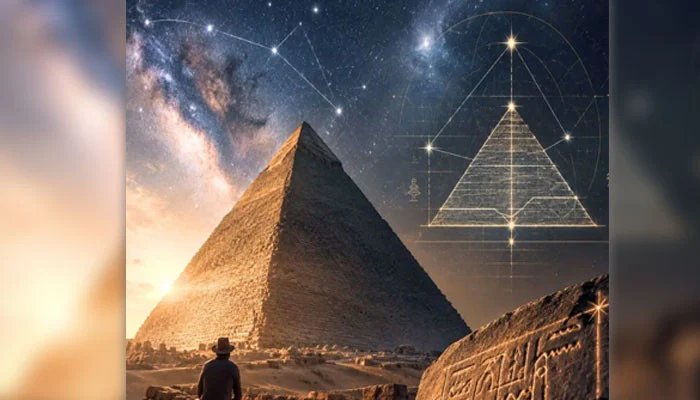

According to a new theory, the Great Pyramid of Giza in Egypt may contain a hidden mathematical system related to the moon, stars and planets.
According to the British newspaper, researcher Sefi Levy says that there are numerical patterns in the various measurements of the pyramids of Egypt, including the height, base and sloping sides, which reflect the mathematical and astronomical knowledge of the ancient Egyptians.
This theory is based on a paper published in SSRN, but the research has not yet been formally peer-reviewed.
What does this theory say?
Sefi Levi evaluated the main measurements of the Great Pyramid using the formulas associated with ancient Egyptian mathematical methods.
He claims that some of the numbers obtained from this process bear a striking resemblance to astronomical cycles and mathematical constants.
According to the report, a calculation yielded a figure of 27.5, which Sefi-Levi describes as approximately the 27.55-day interval between two successive perigees of the moon.
The lunar perigee refers to the point where the moon is closest to the earth.
Another calculation yielded a number of 70, which the researchers associate with the 70-day period when Sirius was not visible due to intense sunlight.
Sefi Levi further claims that certain calculations correspond to the movements of various planets including Jupiter, Saturn, Venus and Mars. The theory also points to possible connections to mathematical constants such as pi (π) and the Golden Ratio.
Was this code added to the pyramid on purpose?
To find out if these patterns could have just happened by chance, Sefi Levy compared the results from 100,000 computer-generated pyramid models.
According to him, about 2.4 percent of the models were found to have similar patterns.
They say this result points to the possibility that the measurements of the Great Pyramid were deliberately arranged in a certain way, but it does not prove that the ancient Egyptians built the Great Pyramid as a mathematical or astronomical code.
The Great Pyramid was built around 4,500 years ago during the reign of Pharaoh Khufu and is traditionally considered to be part of Khufu’s burial complex.
Reportedly, Sefi Levi offers a different interpretation, suggesting that the pyramid may have been designed not simply as a tomb, but also for the permanent preservation of ancient knowledge.
They also suggest the possibility that it may be related to ‘Benben’, which in ancient Egyptian creation mythology is described as a sacred primordial mound at the beginning of the creation of the universe.
These claims are currently speculative and have not been recognized as authentic archaeological evidence.
Nevertheless, the theory certainly offers a new angle to the long-running debate about the purpose and architectural design of the Great Pyramid, one of the world’s oldest and most famous monuments.