









[ad_1]
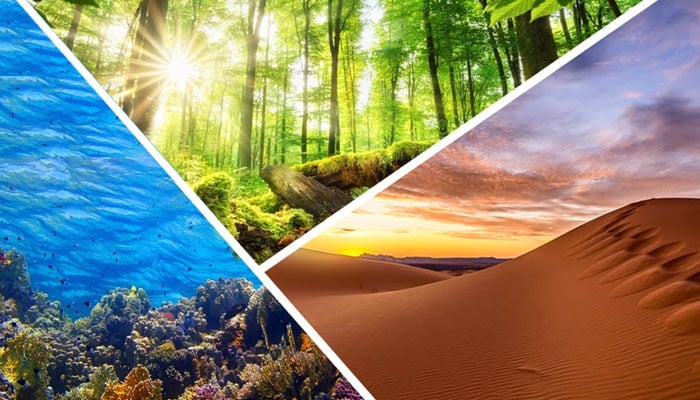
Ecosystem refers to the interrelationship between the members of any family living in the different parts of the planet earth, especially the aquatic life and the living things in the stone sphere, and the inanimate objects for its temporary physical and qualitative environment, while a large group consisting of the population of different types of living things that live together in the same type of habitat and live under the same environment is called “community” (eco). Different living and non-living things of the system” interact with each other.
From modern research and analysis, it is revealed that the main role in this system is soil and water together, while other inanimate objects such as light, oxygen, etc., this system definitely gets the turbulence, balance and strength of life. Yes! However, if these components are contaminated, there are negative effects on the “ecosystem”, which poses a threat to aquatic life.
The cornerstones of this system are called producers, which are related to plants or plants that obtain their food from the raw materials in the environment by themselves, while animals or animals are those that cannot produce their own food, but depend on other living organisms.
These are the users. All consumers (be they primary, secondary or tertiary consumers) are paper dependent on producers and on each other. Consumers are generally considered animalistic. Apart from this, living organisms that cannot prepare their own food and cannot eat other living organisms, but their nutritional needs are met due to the decay, decay and decomposition of dead bodies, then this type of animal is called a decomposer.
All these plants and animals are the living components of the “ecosystem” while water, food, air, oxygen and light are non-living things called Abiotic Components in which water and water have the most primary importance. As far as mud or mud is concerned, mud was completely absent in the early period of Earth’s creation (Pearly Cambrian period), except for solid frozen lava rocks rich in nutrients.
For example, basalt and granite were present, and on the other hand, volcanoes spewing fire and dust. Since igneous rocks (made of lava) can often be seen frozen on the walls of prophetic pools during the rainy season, it should be remembered that most experts seem to agree on the theory that life originated from a “foamy” ocean-like substance.
Therefore, these phytoplankton species attached themselves directly to the surface of the water without mats in search of nutrients. Some fauna have evolved special adaptations to cling to rock surfaces to resist water flow.
Since water is a universal solvent, the salts, minerals and all the nutrients present in the sediment are converted into solution and deposited in a depression (sea or lake) by the process of water transport. The dissolved salts and nutrients in the solution are used immediately by the floating swimming plants (phytoplankton), as they cannot go deeper to obtain nutrients. The experts who regularly observed all these conditions of nature started to attract them.
Therefore, during (1853-1879)) geochemical analyzes of sediments obtained from previous rocks were given great priority, as a result of which in 1966 in an international conference in Germany, several revelations about the “ecosystem” were revealed from the joint action of sediments and water, in which two phases gained special importance. In the first stage, it was revealed that nutrients obtained directly from the water solution found in the pond form the diet.
Calcium is an important component of plants. Calcium carbonate (limestone) is used by many animals in their growth. Iron also participates in plant growth.
Remember that an average pond contains about 4.5 percent rock and mineral particles, including 5 percent silt, 5 percent decayed organic matter, and 50 percent pore space, which function very well in their separate “ecosystems.”
The pore space in the concrete is the final and necessary composition, thereby the pore space in the concrete is the final and necessary composition. This keeps the water in the pond circulating in the ‘ecosystem’. which contains soluble nutrients and carbon dioxide.
The part of the water reservoir that is one meter deep from the water surface is illuminated by light. If the number of dissolved suspended components is low, then the penetration of light can reach up to 200 meters.
That is why it is called “productive zone”. While the zone deeper than 200 meters is deprived of light, that is why it is called the terminal production zone. All aquatic plants need a lot of carbon dioxide in their photosynthesis. It is present in carbonates and bicarbonates of calcium, magnesium and other salts.
Plants, such as diatoms, and animals, such as rhododendrons, use rhodiolarine as food, but its presence is fatal for them.
Turbidity of water depends on the amount of oxygen and soluble nutrients in it. In general, in the littoral zone, oxygen is dissolved in the water from the atmosphere and provided to the families there. And the food chain continues.
If the food chain in the “ecosystem” is to survive, all components of the system must be protected, which requires that all types of industrial radioactive waste (be it solid, liquid, or gaseous waste) be disposed of in sanitary landfills. For example, underground salt layers are selected for very high concentrations of trace elements that are being used around the world.
[ad_2]