









US President Donald Trump has threatened that every country that provides an economic ‘lifeline’ to Iran will be financially punished, he has also declared an ‘economic D-Day’ against Tehran.
The threat is the latest attempt by Trump to use US economic power to achieve his foreign policy goals.
The move comes after several damaging trade wars in the early part of his second term.
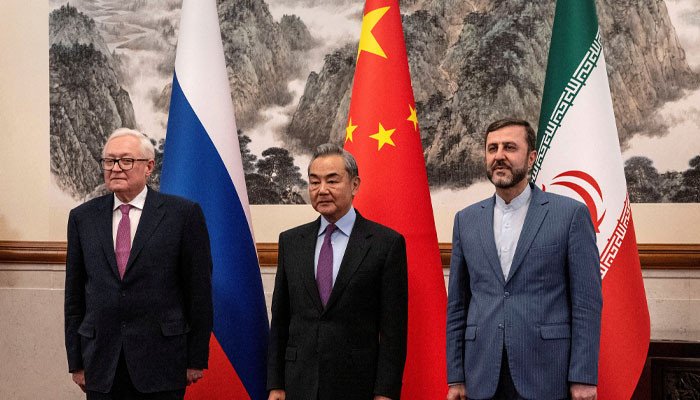
In this regard, analysts say that Trump’s pressure on Iran’s two main trading partners, China and Russia, is limited.
According to analysts, Russia is already under extensive US sanctions and largely operates outside the US-led global economic system.
On the other hand, China has repeatedly shown that it does not hesitate to ignore US sanctions if its own economic interests demand it.
Paul Musgrave, Associate Professor of Government Department at Georgetown University Qatar, while talking to Arab media, said that it will be extremely difficult for Trump to effectively succeed in his pressure campaign.
He said Trump is trying to unilaterally impose coordinated sanctions that traditionally require multilateral cooperation, and that means bringing together China, Russia and the five permanent members of the UN Security Council.
Huge economic consequences
US President Trump has said in a post on his social media platform Truth Social on Tuesday that his campaign against Iran will be the most destructive economic action against any country in history.
He said that the countries that helped Iran avoid the US sanctions will have to suffer huge economic consequences.
Trump cited sources such as oil smuggling, currency exchange facilities, cash transfers, exchange houses, ship registries and front companies, saying that all of this must be stopped, right now.
They say the US could also try to put pressure on Iran’s other trading partners, especially China, its largest trading partner.
China’s oil refineries are difficult to target
Any US plan to influence trade between China and Iran would face significant obstacles.
China will buy 80 percent of Iran’s seaborne oil exports in 2025, according to Calper data, but China’s oil refineries are often difficult to target, as most of them operate independently and have little dependence on the U.S. financial system.
The United States has threatened that major Chinese banks could be subject to sanctions if they channel Iranian funds. Such sanctions would certainly be harmful to China, but could also result in countermeasures from Beijing in a sensitive diplomatic period.
Yu Jie, a senior research fellow at think tank Chatham House’s China and Asia-Pacific Program, said Trump’s threat to target Iran’s economic allies would not change China’s involvement and existing trade relations with Iran.
He has said that Trump wants to stabilize relations with China, so Beijing also wants a temporary truce with Washington because the two countries are currently in a kind of economic cold war.
Parallel relations with Russia
Russia presents a different kind of challenge to Washington.
Although Iran’s trade volume with Russia is smaller than with China, Moscow and Tehran have over the years developed important trade and military ties that operate outside the Western system.
In January 2025, the two countries, facing severe US sanctions, signed a 20-year partnership agreement, which, according to Russian Energy Minister Sergei Tsyulev, will increase trade between the two countries to $4.8 billion in the first 11 months of 2025.
Apart from oil under sanctions, Russia and Iran have also reportedly exchanged arms and military equipment through the Caspian Sea.
Economic terrorism
Iran’s foreign minister on Wednesday sharply criticized the economic campaign launched by the United States against the country, saying it was a continuation of Washington’s failed policies, which would lead to further defeat.
Abbas Araqchi wrote in his post on X that US economic terrorism is a threat to the global economy and sovereignty around the world.
Iran has also tried to use its membership in the BRICS organization, which includes Russia, China, India, Brazil and other major world powers, to find new financial avenues.
Last week, the governor of Iran’s central bank, Abdul Nasser Hamati, said Iran plans to join the BRICS New Development Bank (NDB), which could open up more avenues for financing outside Western markets.
He also said that Iran believes that BRICS member countries can transact in their own currencies and Tehran is exploring the possibility of bilateral and trilateral financial cooperation with other BRICS member countries.
The NDB has not yet commented on Iran’s potential membership, which would have to complete the formal membership process.
Ali Akbar Dariani, an analyst at the Tehran-based Center for Strategic Studies, said that despite stifling US sanctions, Iran will find a way forward, adding that Trump is locked in a war he can neither win nor get out of.