

“What if our AI bullishness continues to be right… and what if that’s actually bearish?”
That single question from a Substack newsletter sent shockwaves through financial markets on February 24, 2026 — triggering a Dow sell-off of over 800 points and going viral with 16 million views on X. The Citrini Research report has since gone BREAKOUT across every major search and finance platform, with readers hunting for the Citrini report, the Citrini Research AI report, and every related Citrini Research article they can find.
What Is the Citrini Report? And Who Is Alap Shah?
The Citrini Research report — formally titled “The 2028 Global Intelligence Crisis Citrini” — was published on Substack by James Van Geelen, founder of Citrini Research, and co-authored with Alap Shah, Co-Founder and CEO at Littlebird and Managing Partner at Lotus Technology Management.
Alap Shah Citrini is an important name to know here. Shah provided the original idea for the piece and has written two companion essays in a broader series called The Intelligence Explosion, which Van Geelen highly recommends reading alongside this report. The partnership between Van Geelen’s macro framework and Alap Shah’s structural thinking is what gives this Citrini Research AI report its unusual depth.
Van Geelen, a former Los Angeles paramedic with degrees in biology and psychology, built his following on “second-order thinking” — the discipline of looking past the immediate headline to see what must logically come next. His reported real-world investment portfolio has surged over 200% since May 2023. When he and Alap Shah put a scenario into words, markets listen.
The report went viral almost immediately. Michael Burry — of The Big Short fame — shared it on X with the caption: “And you think I’m bearish.” On Citrini Research Reddit, finance communities exploded with debate, with threads going viral across r/investing, r/economics, and r/wallstreetbets within hours.
“The loans were good on day one. The world just…changed after the loans were written.” — Citrini Research
The Core Thesis: The Intelligence Premium Is Being Repriced to Zero
The central idea of this Citrini Research article is both elegant and deeply unsettling. Throughout all of modern economic history, human intelligence has been the scarcest and most valuable input into the economy. It is the reason white-collar professionals command premium salaries. It is the foundation upon which the global middle class was built.
The Citrini report thesis: that premium is evaporating. As AI systems become competent substitutes for complex cognitive tasks — legal analysis, financial modeling, software engineering, medical diagnosis — the wage differential that once made knowledge work so valuable begins to compress, then collapse.
Key numbers from the hypothetical 2028 scenario in the Citrini Research AI report:
- 50% of U.S. jobs are white-collar
- 75% of U.S. discretionary spending is driven by white-collar workers
- 46% — labor’s share of GDP in the 2028 scenario (down from 56% in 2024, the sharpest decline in modern history)
The scenario imagines a world where the S&P 500 peaked near 8,000 and Nasdaq broke 30,000 in late 2026, as corporations posted massive margin expansions by replacing human labor with AI. On paper, the economy looked extraordinary. But beneath the surface, something was breaking.
Ghost GDP: The Economy That Shows Up in Data but Not in Your Wallet
The Citrini Research report coins a now-viral term: “Ghost GDP.” It refers to economic output that registers in national accounts — productivity figures, corporate earnings, GDP growth — but never actually circulates through the real economy.
The reason is stark: machines spend zero dollars on discretionary goods. When a human worker is replaced by an AI agent, the company’s costs fall, margins rise, and profits accumulate to shareholders. But the displaced worker’s wages — which would have been spent at restaurants, on rent, on consumer goods — simply disappear from the circular flow of the economy.
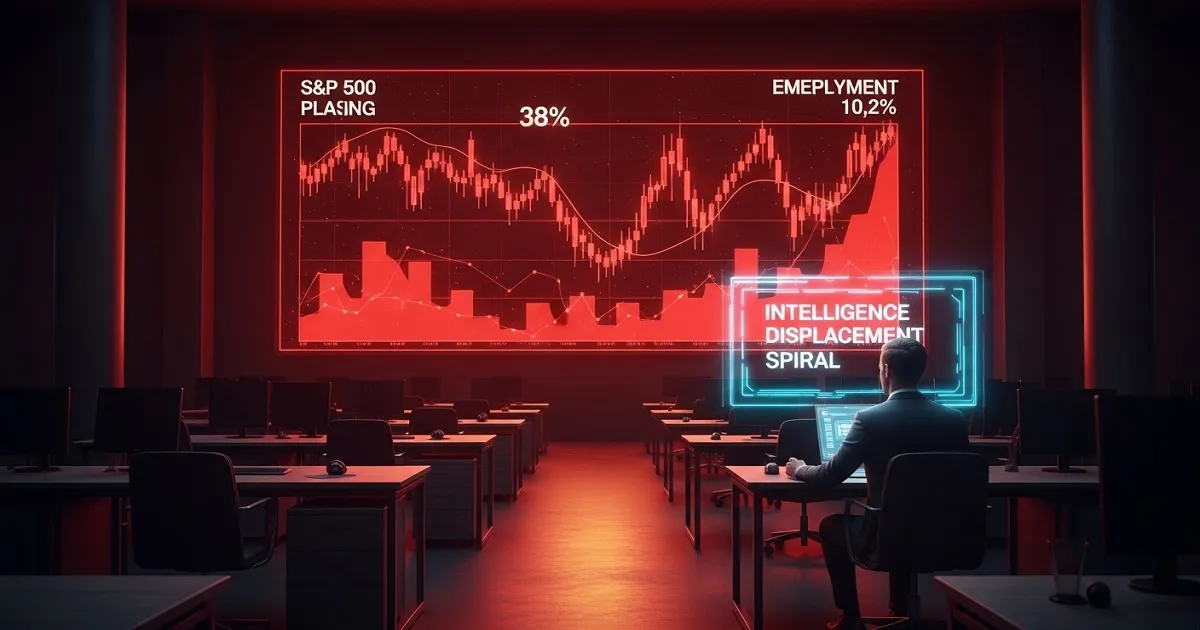
“AI capabilities improved. Companies needed fewer workers. White-collar layoffs increased. Displaced workers spent less. Margin pressure pushed firms to invest more in AI. AI capabilities improved.” — The Displacement Spiral, Citrini Research
This is what the Citrini report calls the “negative feedback loop with no natural brake.” The traditional tools central banks reach for — interest rate cuts, quantitative easing — cannot solve technological substitution. You cannot make hiring more attractive through cheap money when a $20/month AI subscription outperforms a $200,000/year analyst.
How the 2028 Global Intelligence Crisis Citrini Scenario Unfolds: A Timeline
In the Citrini Research article‘s hypothetical narrative, the crisis doesn’t begin with a crash. It begins with a boom — and an invisible rot beneath it.
Early 2026 (Now) S&P 500 near all-time highs. The initial wave of white-collar layoffs begins. Markets celebrate margin expansion. The canary is alive — but barely singing.
October 2026 S&P 500 reaches ~8,000. Nasdaq breaks 30,000. Corporate euphoria peaks. Productivity figures hit levels not seen since the 1950s. Real wage growth quietly collapses.
April 2027 Mastercard reports “agent-led price optimization” and “pressure in discretionary categories.” Purchase volume growth slows. Markets begin recognizing that the AI “toll-booths” of finance are being eliminated. Card-focused banks crater.
Late 2027 The $2.5 trillion private credit market cracks. AI-boom-era software LBOs begin marking down. SaaS revenue models erode as AI eliminates the value of subscription software. Private marks disconnect from public reality.
June 2028 Unemployment: 10.2%. S&P 500: −38% from highs. San Francisco home values: −11% YoY. The $13 trillion U.S. residential mortgage market — underwritten on the assumption of stable white-collar employment — is under systemic threat.
This Is Not 2008. It’s Worse in a Different Way.
Perhaps the most chilling section of the Citrini Research report concerns the U.S. housing market. Unlike Citron Research — the well-known short-selling firm — or Citrin Research (a separate entity often confused with Citrini in search results), Citrini Research focuses on macro scenario analysis rather than individual stock calls. And this scenario is macro in the fullest sense.
Every prior U.S. mortgage crisis was caused by one of three things: speculative excess (subprime lending), interest rate shocks, or localized industry collapses. None apply here. The borrowers in the Citrini report‘s 2028 scenario are not subprime. They have 780 FICO scores. They put 20% down. They had verified incomes, clean credit histories, and documented employment.
The Core Risk: Mortgage underwriting is built on the assumption that the borrower will remain employed at roughly their current income level for the duration of the loan. In 2008, the loans were bad on day one. In the 2028 scenario, the loans were fine on day one. The world simply changed after the loans were written — and no risk model in the financial system was designed for that.
If the income assumptions underlying $13 trillion in U.S. residential mortgage debt begin to fail — not because borrowers were irresponsible, but because the entire category of employment that underwrote their mortgages became economically obsolete — the Citrini Research AI report warns the resulting drawdown could rival the Great Financial Crisis.
How a Substack Post Moved Billions in Market Cap
The Citrini Research article — clearly labeled as a thought experiment — triggered one of the more unusual market sell-offs in recent memory. The Dow fell more than 800 points. Market breadth was brutal, with just 27% of stocks advancing.
On Citrini Research Reddit threads, investors debated whether the sell-off was rational or an overreaction to speculative fiction. The consensus: the report didn’t create the fear — it articulated a fear that was already there.
Companies whose business models depend on “friction” — the imperfect, slow, human-mediated processes that AI systematically eliminates — were hardest hit. DoorDash, American Express, KKR, and Blackstone all fell more than 8%. Uber, Mastercard, Visa, and Capital One were each down at least 3%.
The sell-off was amplified by real-world confirmation. Anthropic announced the same day that its Claude Code tool could automate the exploration and analysis phases of COBOL modernization — potentially compressing years of work into quarters. IBM fell nearly 12%. COBOL maintenance is a $30 billion annual market, and its clients stay locked in precisely because of the complexity AI is now dissolving.
“The market sold off hard on a work of speculative fiction. The market has shown incredible resilience in the face of actual bad news, yet a hypothetical scenario sent it into a tailspin.” — TheStreet Pro, February 24, 2026
Citrini vs. Citron vs. Citrin: Clearing Up the Confusion
Search traffic for this story has surfaced significant confusion between three similarly named entities. For clarity:
Citrini Research (this report) — a macro analysis and investment research publication on Substack, founded by James Van Geelen. The Alap Shah Citrini collaboration refers to this outlet. This is the source of The 2028 Global Intelligence Crisis Citrini report.
Citron Research — a well-known short-selling firm run by Andrew Left, famous for publishing bearish research on individual stocks. A completely separate organization from Citrini Research.
Citrin Research (also appearing in searches as “citrin research”) — likely a misspelling of either Citrini or Citron. Not a known independent research entity.
If you found this article searching for the Citron Research report on AI or Citrin Research, you were most likely looking for this Citrini Research report — they are frequently mixed up in trending search results.
The Bull Case: What the Citrini Report May Be Missing
The Citrini Research article has its critics. The most substantive counterargument comes from economic history: productivity gains don’t destroy value, they redistribute it.
Tom Lee of Fundstrat has pointed to the invention of flash-frozen food in the early 1900s, which disrupted farming’s share of employment from 30–40% down to just 2–5%. Yet the economy didn’t collapse — it reallocated. New industries and new categories of demand emerged that nobody predicted at the time.
Critics also note that the Citrini report‘s “Ghost GDP” argument assumes displaced wages permanently vanish. In theory, when AI drives costs down, goods and services become cheaper, effectively raising real purchasing power even for households with lower nominal incomes. The “freed-up value” should eventually re-route somewhere.
On Citrini Research Reddit, some of the most-upvoted pushback mirrors this: that the report models a transition period as if it were a permanent equilibrium, and that human adaptability has consistently outpaced the pessimists of every prior technological era.
The Canary Is Still Alive. But It’s Coughing.
Alap Shah and Van Geelen are careful to close the Citrini Research report with nuance. “Repricing is not the same as collapse.” The economy can find a new equilibrium — but only if institutions, investors, and policymakers begin adapting now, while there is still time to be proactive.
As of February 2026, the S&P 500 is near all-time highs. The negative feedback loops have not begun. The 2028 Global Intelligence Crisis Citrini scenario has not materialized. The report’s authors are “certain that some of these scenarios won’t materialize.”
But the question the Citrini report forces us to confront is not whether 2028 is a prediction. It is whether our portfolios, our mortgages, our career assumptions, and our policy frameworks are built on premises that will survive an intelligence explosion — or whether they quietly assume that human intelligence will always be the scarcest thing in the room.
That assumption may be the most expensive one anyone has ever made.
“Getting there is one of the few tasks left that only humans can do.” — Citrini Research, closing line
This is an editorial summary of publicly available research. It is not financial advice. The original Citrini Research report by James Van Geelen and Alap Shah is available on Substack at citriniresearch.com.
