










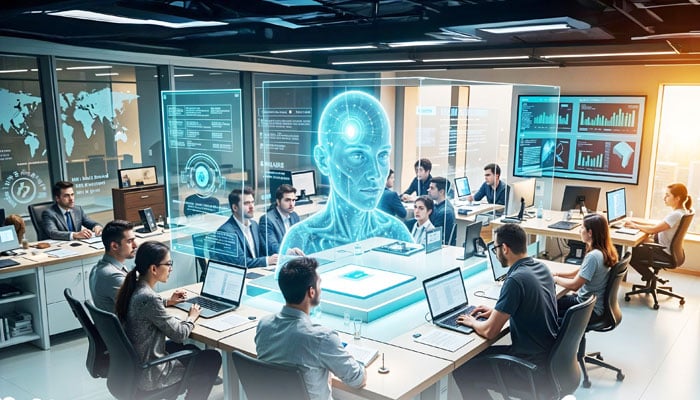
The world has entered an extraordinary era where the pace of scientific and technological progress has been many times faster than at any time in human history. Not only has the time horse picked up speed, it is also changing directions.
The changes that took place in the last decade in fields such as artificial intelligence, quantum computing, biotechnology, nanoscience, space exploration and the digital economy are not just scientific inventions, but are precursors to reshaping human lifestyles, economy, politics and even consciousness.
In this article, we will analyze some of the basic trends and developments of the present day that are making the world of tomorrow not only possible but also unpredictable.
The Global Revolution of Artificial Intelligence
The Rise of Machines Artificial Intelligence (AI) is no longer just a toy of laboratories or corporate software, but has become a central part of everyday life. GPT-4, Gemini, Claude and other multimodal AI models have not only given new direction to fields such as education, health, justice and journalism, but have also challenged the very nature of human decision-making.
Not only can AI create content, it has also become capable of understanding emotions, tone and social context. In some European countries, doctors’ AI assistants have succeeded in diagnosing patients with 90 percent accuracy.
Not only that, 40 percent of jobs in the world’s major economies are predicted to be affected by AI by mid-2026. The problem is not only limited to employment and economy, but it has also become a problem of human identity, creativity and autonomy.
Quantum computing
New on the scientific horizon is quantum computing, a field that is radically changing the boundaries of traditional computing. Google, IBM and Chinese companies have recently successfully tested quantum computers that can perform calculations in a second that would take supercomputers thousands of years.
Quantum supremacy is no longer a theoretical concept, but has become a reality. In mid-2026, IBM has announced the launch of a quantum system containing more than 1000 qubits, which will play a revolutionary role in the fields of medicine, climate modeling and encryption. Quantum cyber security is now the new battleground for states.
Existing encryption techniques could be broken by quantum computers, leading to a new worldwide data security crisis. Commercial applications of quantum computing are also developing rapidly.
Pharmaceutical companies are accelerating the discovery of new drugs with quantum computers, while financial institutes are developing models of stock market patterns and economic crises.
Space exploration
From Mars to the Moon and Beyond Humanity currently has rockets that pave the way for a return to the Moon, colonization of Mars, and travel to other planets. SpaceX, Blue Origin, China’s CNSA and India’s ISRO have crossed important milestones in space research. Preparations to send humans back to the moon under NASA’s Artemis program in early 2026 have been completed.
Also, AI robots are often sent on Mars missions instead of humans, which are engaged in ground exploration, mapping, and looking for signs of water. Jeff Bezos’ Blue Origin and Elon Musk’s SpaceX are in the race to make space travel accessible to ordinary people. In the next ten years, plans for space hotels and the first human population on the moon could become a reality.
The convergence of human mind and machine
Projects like Neuralink are making human-machine integration a reality. Recently Elon Musk’s company has implanted the first successful computer chip in the human brain that can not only directly read brain activity but also control machines through nerves.
This development is not only revolutionary for disabled people but also raises a moral question that if the difference between man and machine begins to disappear, then what will be the meaning of “human identity”? Is there ever going to be a time when humans can back up their memory or store their thoughts on the cloud?
Positive aspects of this technology include the treatment of stroke and neurological diseases and the restoration of memory. But on the negative side there is also the threat of mental slavery, theft of ideas and a new kind of human division.
The Digital Economy and the Future of Crypto
Cryptocurrencies, blockchain and Web3 have shaken economic systems around the world. Although many countries have outlawed crypto, the adoption of the digital currency continues. China has launched its official digital currency, the “Digital Yuan”, while the US and Europe are also working on their own CBDCs.
Blockchain’s transparency and ability to keep immutable records is making it applicable not only in currency, but also in sensitive areas such as elections, education, property and medical records. In 2025, several countries successfully tested blockchain-based voting systems, paving the way to reduce the possibility of electoral fraud. Countries joining the digital economy are developing rapidly, while countries with traditional economies are at risk of being left behind.
Biotech and genetic modification
CRISPR-Cas9 (CRISPR-Cas9) and the modern technology of gene editing are not only giving humans the ability to cure diseases, but the concept of “designer babies” is now moving from research to reality. In late 2025, China successfully treated hereditary diseases such as thalassemia and sickle cell anemia through genetic modification, which has sparked a global ethical and scientific debate. However, it is certain that biotechnology will completely change the medical world of the future.
Prosthetics and bionic eyes are also developing rapidly in recent years. Scientists are developing artificial muscles that are much stronger than human muscles. Bionic eyes are providing partial vision to the blind. All these developments point to a world where the concept of disability will disappear.
Climate Change and Scientific Answers
Rising global temperatures, melting polar ice caps and extreme weather events have now become the biggest challenges for humanity. According to a United Nations report, 2.5 billion people in the world will suffer from severe water scarcity by 2026. The answer is being given with the help of science and technology, including “cloud seeding”, artificial rain, carbon capture technologies, and new models of solar energy.
Countries like Pakistan also have to invest in these technologies soon, to avoid the effects of environmental crisis. In recent years, the concept of artificial lungs and carbon cleaning buildings has also come up. Buildings are being constructed in Singapore that not only generate their own energy but also absorb carbon dioxide from the atmosphere.
Robotics, drones and automated warfare
The use of drones, robots, and AI weapons increased last year in the Ukraine-Russia war and Israel’s attacks in the Middle East. The US, China, Israel and Turkey are leading the way in automated warfare systems. With the use of these weapons, the battlefield has become more machines than humans.
This trend points in a dangerous direction that if man does not regulate automatic weapons, in future wars will be fought with a mere “code” and human life will be devalued.
The ethical aspects of automatic weapons are being debated internationally. According to a United Nations report, by the end of 2026, more than 50 countries around the world will have automated warfare systems. Such wars have also increased the risk of cyber attacks, where an enemy can hack into a country’s electricity grid, water supply and hospital systems.
Future education
New Challenges, New Opportunities The rapid development of technology has also affected the education sector. Through Virtual Reality (VR) and Augmented Reality (AR), students can now visit historical sites or conduct scientific experiments. AI can provide personalized learning for each student.
However, these developments also raise a larger question. Will the need for humans end? Will AI teachers replace human teachers? Educational institutions not only have to adopt new technologies, but also develop skills like critical thinking, creativity and emotional intelligence in students.
World politics and the new balance of power
The technology race has also affected the balance of world politics. The technology race between the US and China has turned into a new cold war. China is trying to overtake the US in artificial intelligence, 5G and quantum computing.
The EU is taking a balanced path in terms of technology, where it embraces new technologies while also imposing appropriate regulations on them.
Morality and the Human Future
Despite all these developments, the most important question is whether humanity is morally ready for these changes. Can our moral values, laws, and social structure change as fast as technology is changing?
Artificial intelligence threatens to widen the gap between rich and poor. Countries that have these technologies will reach new heights of development, while other countries will lag behind.
A moment of choice
At this critical juncture in human history, we must decide whether we will use these inventions for the betterment of humanity or for destruction. Will we create a world where humans and machines work together, or a world where humans become slaves to machines? The decision depends on our collective wisdom, moral values and academic and research priorities.
We have to focus not only on technological development, but also on human values, ethics and spiritual development. Balance is the only path that can take humanity to the heights of development, otherwise these developments can lead to our destruction.
The future depends on our choices. We must create a future where technology serves humanity, not humans becoming slaves to technology. This is the real challenge of the modern age and this should be the focus of our hopes and dreams.