









Our present earth on which we walk, breathe, live is not a product of this moment, but the result of a long evolutionary process spanning about 4.5 billion years. The cloud of gas and dust scattered around the primordial Sun began to form solid bodies, collide, merge into larger bodies, and eventually into planets. During this process, the early form of Earth, the proto-Earth, came into being, but that state did not last long.
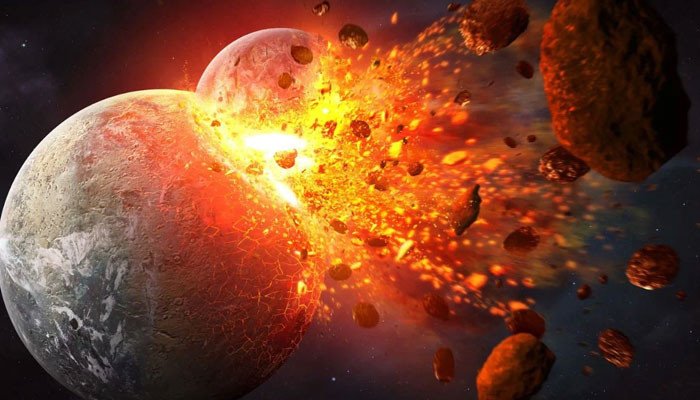
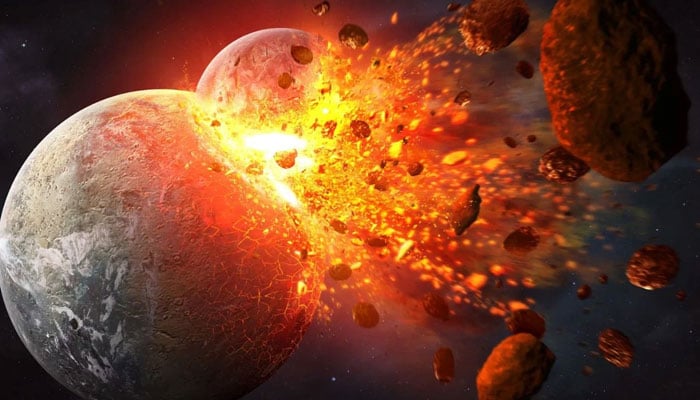
At least according to traditional theory, a giant collision (such as the Giant-Impact Hypothesis) almost completely changed this initial state and gave rise to the fragmented form of our Earth. But recent research has shown that tiny, but important components of this early Earth may still be present in our Earth, especially in its interior.
That is, those “lost worlds,” those primordial components that we expected to have been destroyed, may still be preserved deep within our Earth. This discovery can be an important milestone for the study of the origin, evolution and planetary formation of the Earth.
Traces of collisions, meteorites and isotopes
Traditional models suggest that Earth first formed 4 to 5 billion years ago. During this time, solid materials collided to form large bodies and the Earth formed, then suffered a collision in a phase known as a giant impact, in which a Mars-sized body collided with the proto-Earth, drastically changing the Earth’s internal structure and chemical composition. The same process is also theorized to lead to the creation of the moon.
According to this model, the Great Collision mixed the primordial components into a nearly metamorphosed state and wiped out the remnants of material that had previously existed. Therefore, scientists continue to assume that those components of proto-Earth are no longer available or at least not found on the surface.
But modern analyzes have shown that the composition of Earth’s “bulk silicate Earth,” that is, its overall chemical and isotopic composition, is not fully explained by the composition of the meteorites we have.
This question has led researchers to think that the proto-Earth may have had specific isotopic signatures that differed from the later composition, and if those signatures are still preserved somewhere today, we may have direct evidence of Earth’s early state.
MIT research and potassium isotopes
Led by Nicole Nie, the MIT team looked for “potassium isotopic signatures” (K isotopes) in various ancient and deep-earth rocks. Among them, the ratio of the isotope (Potassium 40 k) was particularly important, because this isotope is found in relatively small amounts and its changes are important as chemical markers.
The team analyzed ancient volcanic rock samples, such as the oldest rocks in Greenland, Canada, and volcanic material (boiled from the Earth’s deep mantle) in Hawaii. The samples were separated from potassium and later measured by mass spectrometry for three isotopes ³K, ⁴⁰K, ¹K. It was found that the amount of K in these samples was less than normal.
That is, there was a significant deficiency. For example, the reduction was at a level of about 65 parts per million (ppm), which was significant compared to other Earth samples. This reduction meant that these materials belonged to an initial state that was different from the mixed state after the giant impact, i.e., they could be materials believed to be components of the “proto-Earth” that were not completely changed by the later deformation.
Material stored in modeling and layers
Another team studied the composition of meteorites and ran computer models that looked at how different collisions, mixing and grounding processes might have changed this isotopic signature. Based on this, it was concluded that the isotopic composition of the modern Earth is the result of this initial state change and that the K-deficient samples are the materials that were preserved in zones less affected by this change.
So! The discovery suggests that the inner layers of our Earth may contain ancient components that belong to this early lost world, a fact that scientists have been searching for for decades. A few important aspects are worth noting in the conduct of this research.
Isotopic composition, the ratio of isotopes, can be a sign of the origin, history, and evolution of planetary material. Specifically, the research team measured “mass-independent” potassium isotopic changes that cannot be produced by biochemical or magmatic processes. For example, if there was only magmatism or surface activity, a certain change would be likely, but the decrease they measured could not be explained by these factors.
The team used samples from existing meteorites and modeled how the materials inside might have changed over time if there was a proto-Earth that later suffered a giant impact. From this, it was calculated that if the early materials were K deficient, this deficiency could have been gradually eroded by small collisions and terrestrial mixing after the giant impact.
Ancient treasures in deep mantle layers
Thus the common isotopic composition of the modern Earth is found at today’s surface. This modeling led to the conclusion that the samples in which the reduction was observed could be internal material that was not affected by large-scale mixing, i.e., that was left over. An important conclusion is that complete mixing has not occurred in the Earth’s mantle.
That is, not all layers of the Earth necessarily have the same isotopic composition. These results indicate that there are “reservoirs” in the deep mantle that have remarkably preserved their isotopic identity despite billions of years of mixing.
This research shows us that our Earth was not just a unified mixed body, but that its inner layers may contain material similar to its proto-state. The discovery raises new questions about planet formation, the reality of meteorites, Earth’s internal mixing processes, and the early material of the Solar System.
Researchers have demonstrated that there are materials within the Earth with a different isotopic signature than the rest of the Earth, identified as K-deficient, and preserved despite the giant impact and billions of years of terrestrial processes.
This research reminds us that our Earth is not only a product of the moment, but also a fragile image of a very distant past, an image whose components are still preserved beneath the surface of the earth.