









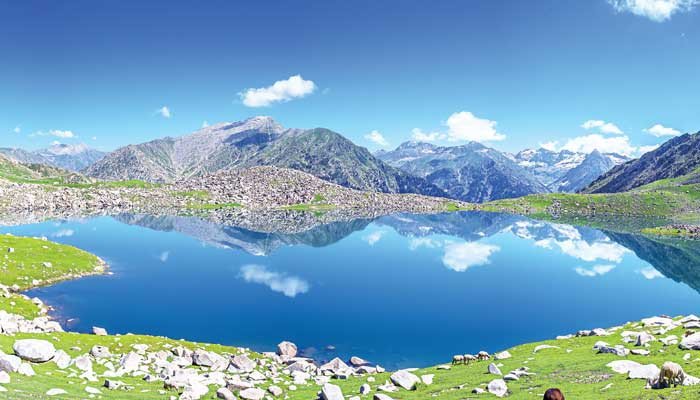
In recent research, the lake has been described as an important part of the physical features on the surface of the earth, which has been created through natural factors such as: tectonic movements that are present in different countries of the world.
The surface of the lake is recognized as an important and beautiful part of the natural landscape on earth. For this reason, land imagery has been very popular in art and poetry, but with the passage of time, its importance became more prominent when it was used for transportation, industries, agriculture and electrical energy, and it began to have positive effects on human life. Then the fact that the concentration of valuable mineral components (eg gold, diamond) with high density in some lakes was also known, then its importance became doubly important.
This is the point when science and scientists turned to explore the hidden natural causes of lake creation, through which they became aware of the fact that a lake is actually a structure on the surface of the earth, the occurrence of which is under the influence of natural factors.
This structure is a pit without water, called a “Basin” in geological sciences, in which water is trapped from various sources, due to which it becomes a source of small water storage in the surrounding areas.
which is surrounded by land which is called “lake basin”. Its water is both sweet and salty, its location and stay are permanent and temporary. Sometimes, when the river course travels in a meandering way, a soft part of it separates from the channel and is present on land in the form of Oxbow Lake.
River water around the world goes through a complex cycle called the “water cycle”. For example, sea water evaporates from the heat of the sun and is subjected to the process of evaporation.
During this journey, they stray from their passage and get trapped in the nearby lake basin. Almost all geological processes result in the formation of a basin or depression that becomes a lake due to the impoundment of water. Provided that the supply of water continues to be equal. Any small depression can turn into a small lake or pond during wet periods. A large lake that is permanent.
It depends on the process that takes place during the formation of the basin. For example: Any tectonic movements can create a moving and durable basin that appears in a lake basin over time, in this regard, a fault means the rock breaks and slides from its place in two blocks. Often creates many different types of lake basins.
If the fault block is tilted to one side, the lake forms in the mid-slope of the tilted block. Several such lakes are located a few miles south of San Francisco along the San Andreas Fault in California.
Lake formation is also found in the Rift Valley. Lake Baikal, the deepest lake in the world, is located in Central Asia. Attesting to the variety of ground motions, 5712 feet deep, the largest and deepest rift valleys have been found in East Africa, of which two rift valleys exist in the form of large lakes. Such lakes are found in mountain ranges in the western United States, but disappear as the climate dries out.
For example: A crater formed by volcanic activity can be filled with water at any time, resulting in a lake basin. Fire Pit in Oregon is an example of such a lake. Apart from volcanic eruptions, lakes are also created by other means. For example: Mudflow, landslides and the movements of mountains also contribute to the replenishment of the lake.
In arid climates, water collects in depressions forming small lakes, which are formed by the erosion of the climate, as the depressions between sand dunes are seen changing into lakes, which are temporary due to the dry climate. Fluvial processes also form lakes in land features, the most important of which is the “bow lake” formed by the erosion of certain parts of the original river channel.
For example: If the banks of a river are eroded due to the attacks of strong currents, the trees and bushes on the banks keep falling into the channel. Moreover, other debris continues to accumulate on this barrier. Similarly, when water backs up behind a barrier, a lake appears on the surface. The deltaic action of the river also leads to the formation of the lake. Often the delta consists of high-bar branches that later join the main channel.
They actually block the course of a large river, causing the flow of water to stop. Sometimes a delta is formed on a river bed by deltaic processes. An example of this type of lake is the Salton Sea in California, which was cut off from the sea and turned into a sea or lake due to the formation of the Colorado River Delta. Lakes are also created due to the melting of glaciers.
There are more than 100 lakes in New York that have left a “gorge” (round chisel-shaped structure) from the solid rock ice sheet, confirming the fact that there were glaciers above the risk in ancient times. When the glaciers began to melt, this created depression filled with water, creating many of the world’s largest lakes, whose water is fresh and sweet.
Here it is important to remember that glacier and river formed lakes are fresh (fresh) water but lakes are also saline, which is why almost all lakes have an outlet. That is why the dissolved salts that flow with the river water form springs. eventually joining the sea, the situation is different if the lake has no outlet.
This happens when the two-way water system in lakes is disturbed. Water continues to be released from the lake and added to it, such lakes are fresh water reservoirs, which are called fresh water lakes, but the lakes around which water is added but not discharged remain stagnant in the valley. Especially the water of the lakes around the sea.
Where the two-way system of water is not correct and they are salty. This type of lake almost resembles an ocean. For this reason, they are called seas, due to the process of evaporation, their dissolved salts, especially sodium chloride, remain in the basin and the water evaporates into the atmosphere. Salt lakes are formed in this situation.
In Western Asia (Asia Minor) there is the world’s largest salt lake, which is called the Casbian Sea, along with Iran. It was formed when an arm of the ocean was cut off due to the uplift of land movements. In this way, there is the Dead Sea in the Middle East and the Great Salt Lake in the western state of Utah in the United States.
This lake is about 350 miles long and 160 miles wide. Lake Victoria is the second largest lake in Africa. Pakistan also has fresh water lake. A beautiful lake is located in the northern region of Pakistan. The lake called “Saif Al Muluk” is a fresh water lake. Apart from this, there are many lakes in the province of Sindh, in which Kanchar Lake and Manchar Lake have great priority.
Lakes have proved to be very ephemeral compared to other natural structures and are constantly undergoing a process of drying up, due to which it cannot be denied that the sources that keep these lakes fresh by supplying them with water also lead to its destruction in one way or another.
When a lake basin is formed, the river that feeds it gradually spreads a layer of silt, clay, silt and silt across its floor, causing the basin floor to gradually fill up over time, and sediment deposition forms a delta in the center of the lake that eventually fills the entire basin with sediment.
According to a survey, this lake will be completely filled in the coming centuries. The lake basin is also filled with debris that accumulates under drainage from the side slopes. The tidal response of the lake water also erodes the banks and deposits the sediment in the basin.
Often there is continuous forest and tree production around the forest boundaries and more and more sediments accumulate around the lake. In this way, gradually the entire lake begins to present a marshy scene.
Also, when the sedimentation process accelerates due to the hot and dry climate of the area, the total amount of water in the marshes evaporates and dissolves in the atmosphere, creating a salt lake. The Great Salt Lake in Utah is an example.