









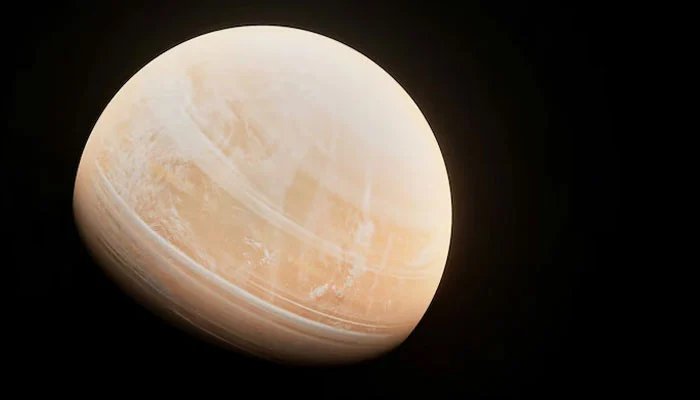
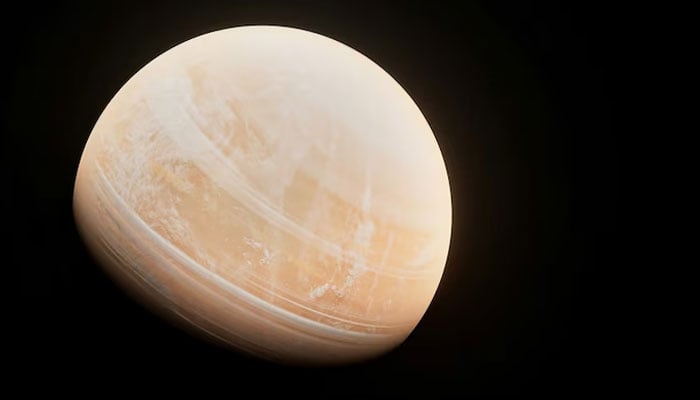
The planet Venus is among the 2 planets in the solar system that do not have any natural moons, and in this regard, scientists have now presented an important theory.
The planet Venus is similar to Earth in size, mass and composition, but has no moons.
Scientists have been trying to find out for a long time why this planet with similar characteristics to Earth does not have its own moon.
A team of researchers led by Dr. Stephen Keen of the University of California evaluated the possibility through computer simulations to find out whether the planet Venus had a moon in the past. And if he was, then where did he go now?
According to the results of the research, the rotation speed of the planet Venus could have played a fundamental role in the future of this possible moon.
The results of the research show that if the planet Venus rotates quickly and its 1 day is less than about 12 hours, then a satellite with the mass of the Earth’s moon could remain stable for billions of years. Hits with.
The new study, published in the Astrophysical Journal, also suggests the possibility that large collisions in Venus’ early history may have caused its current slow and reversed rotation, and that debris from the collision either fell back onto Venus or possibly formed a moon that could not maintain a stable orbit for long.
According to the researchers, Venus didn’t need another major collision later to lose a potential moon, because after the initial collision, the natural forces of the asteroid alone would have been enough to pull the moon toward the planet and eventually destroy it.
Scientists have clarified that the research does not provide conclusive evidence that Venus actually had a moon in the past, but only suggests that the planet’s current lack of a moon could possibly be explained by its rotation and gravitational effects.