
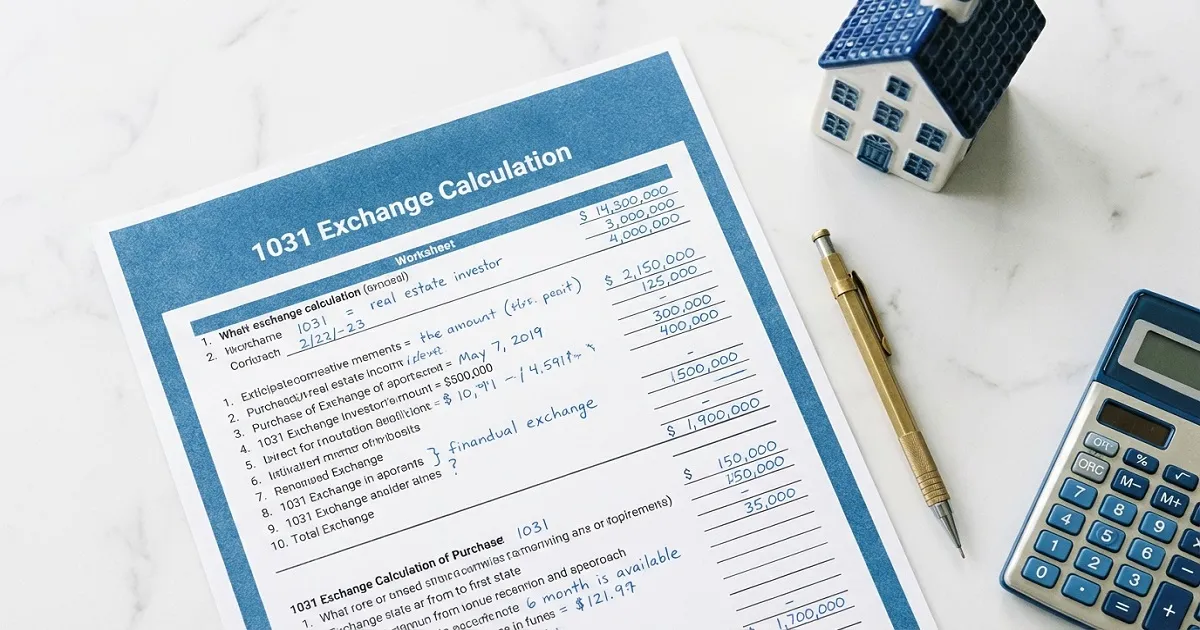

Real estate investors love 1031 exchanges — and for good reason. Done correctly, you can sell a property, roll the gains into a new one, and defer your capital gains tax indefinitely. That’s serious money staying in your pocket and continuing to work for you.
But here’s what a lot of people find out the hard way: the mechanics of a 1031 exchange aren’t just paperwork. The math underneath it matters enormously. One miscalculation and the IRS will treat part of your transaction as taxable income, even if you reinvested every single dollar.
That taxable portion is called boot, and it catches investors off guard more often than you’d think. In this guide, we’ll walk through exactly how a 1031 exchange calculation worksheet works, why the “equal or greater” rule leaves less room for error than people assume, and what the 2026 rules mean for your next deal.
| Quick Answer: A 1031 exchange lets you defer capital gains tax when you sell investment property — but only if you reinvest in a like-kind property of equal or greater value AND equal or greater debt. Miss either of those targets and the difference becomes boot, which the IRS taxes as income or capital gains — plus a potential 25% depreciation recapture rate and a 3.8% NIIT surtax for high earners. |
The “Equal or Greater” Rule — What It Actually Means
The core requirement of a 1031 exchange sounds simple: buy a replacement property worth at least as much as the one you sold, and carry the same amount of debt — or pay cash to make up the difference. In practice, two separate tests trip people up:
- Your replacement property’s purchase price must be equal to or greater than your net sale price (after selling costs).
- Your new mortgage must be equal to or greater than the one you paid off — or you must contribute additional cash to compensate.
Fail either test and you’ve got boot. Boot doesn’t disqualify your exchange — it can still be partially valid — but you will owe taxes on whatever the IRS classifies as boot. That’s why running the numbers on a 1031 exchange calculation worksheet before you identify your replacement property isn’t optional. It’s the difference between a clean exchange and a nasty tax surprise at filing time.
How to Use the 1031 Exchange Calculation Worksheet
Whether you’re working through a spreadsheet you built yourself or using a structured 1031 exchange calculation worksheet, the process follows the same three-step framework. Let’s break it down.
Step 1: Identify Your Original Basis and Adjusted Basis
Your basis is what you paid for the property — but it’s rarely that simple. If you’ve owned it for years, you’ve likely made improvements, claimed depreciation deductions, or both. Those adjustments matter because the IRS doesn’t just look at what you bought and sold the property for. They look at your adjusted basis.
Original Basis: Your purchase price plus closing costs and any improvements made at acquisition.
Less: Depreciation Claimed: Every year you claimed depreciation reduces your basis. This increases your realized gain — and it comes with a specific tax consequence worth knowing about.
| 2026 Tax Detail — Unrecaptured Section 1250 Gain: The depreciation you’ve claimed over the years is not taxed at the standard capital gains rate when you eventually sell. It’s taxed as Unrecaptured Section 1250 gain at a maximum rate of 25% in 2026 — compared to the 15% or 20% long-term capital gains rate most investors are expecting. This is one of the biggest reasons a 1031 exchange is so valuable: it defers that 25% recapture hit, not just the 15–20% capital gains hit. |
Plus: Capital Improvements: Major renovations, additions, or upgrades made during ownership add to your basis and reduce your realized gain.
Once you have your adjusted basis, subtract it from your net sale price. That’s your realized gain — and it’s the number you’re trying to defer with the exchange.
Step 2: Calculate Realized Gain vs. Recognized Gain
This is where the worksheet earns its keep. Two different figures drive your tax exposure:
Realized Gain: The total profit you made on the sale. This is what would be taxable if you didn’t do a 1031 exchange.
Recognized Gain: The portion of that gain the IRS actually taxes. In a perfect 1031 exchange, this is zero. If you received boot, it equals the lesser of your realized gain or the boot received.
| 2026 Expert Detail — The NIIT Surtax: High-earning investors should note that in 2026, recognized gains are also subject to the 3.8% Net Investment Income Tax (NIIT). This applies if your modified adjusted gross income exceeds $200,000 (single filers) or $250,000 (married filing jointly). Combined with the 25% depreciation recapture rate and the top capital gains rate of 20%, your effective rate on a poorly structured exchange could reach 28.8% or higher. A 1031 exchange defers all of it — including the NIIT. |
Getting this step wrong is what causes most of the costly mistakes we see investors make. A lot of people assume that as long as they reinvest in a more expensive property, they’re fine. But if they pocket some cash at closing or take on less debt than they paid off, they’ve triggered recognized gain — even if they bought a pricier replacement.
Step 3: Factor in Mortgage Boot and Cash Boot
Boot comes in two flavors, and your worksheet needs to account for both:
Cash Boot: Any cash you receive from the transaction — whether directly from sale proceeds or because you didn’t fully reinvest. This includes net proceeds sitting with your Qualified Intermediary if you don’t use all of them.
Mortgage Boot: If the mortgage you’re relieved of on the sold property is larger than the one you take on for the replacement property, the difference is mortgage boot. The IRS treats debt relief as cash in your pocket.
The good news: cash boot can offset mortgage boot. If you have mortgage boot, you can eliminate it by bringing additional cash to the closing of your replacement property. Your worksheet should show both figures and net them against each other.
The 2026 1031 Exchange Rules You Need to Know
The fundamental structure of 1031 exchanges hasn’t changed dramatically heading into 2026, but the details matter — especially for investors who haven’t done one in a while or are relying on advice from a deal years ago.
The 45-Day Identification Deadline — and Why the Timeline Diagram Matters
Once you close on your relinquished property, the clock starts. You have 45 calendar days — not business days — to formally identify your replacement property in writing to your Qualified Intermediary. That’s a firm deadline. Miss it and your entire exchange fails.
The IRS allows you to identify up to three properties regardless of value, or more properties if they meet specific valuation rules. Most investors lock in on one or two candidates, then scramble because they didn’t run the numbers early enough. Your worksheet should be ready before you even list your current property.
| 1031 EXCHANGE — CRITICAL TIMELINE | ||
| Day 0 | Property Sold | Close on relinquished property. Funds go to Qualified Intermediary. Clock starts NOW. |
| Day 1–45 | Identification Window | Identify replacement property in writing. Up to 3 properties allowed. This deadline is HARD — no extensions. |
| Day 46–180 | Acquisition Window | Close on replacement property using QI funds. Use your worksheet to confirm no boot before closing. |
| Day 180 | Exchange Complete | Full deferral achieved if all rules are met. File Form 8824 with your tax return. |
| Both deadlines are calendar days (not business days) and run concurrently from Day 0. Missing either deadline disqualifies the exchange. | ||
The 180-Day Closing Rule
From the same closing date, you have 180 calendar days to close on your replacement property. This deadline runs concurrently with the 45-day window — it doesn’t restart after identification. In practice, that gives you roughly four and a half months from identification to closing, which can be tight in competitive markets.
One important note for 2026: if your tax return is due before the 180-day window closes, you may need to file an extension to preserve the full timeline. Failing to do so can shorten your exchange window to your filing deadline.
Why “Like-Kind” Is Broader Than Most People Think
For real property in the US, “like-kind” is surprisingly flexible. You can exchange an apartment building for a retail strip center, vacant land for a warehouse, or a single-family rental for a commercial property.
What you can’t do is exchange US real property for foreign real property, or use a primary residence — it has to be property held for investment or used in a trade or business.
| 2026 Note: The Tax Cuts and Jobs Act permanently eliminated 1031 exchanges for personal property. Only real property qualifies. If you’ve seen older resources referencing equipment or vehicle exchanges, that information is no longer accurate. |
Case Study: Running the 1031 Exchange Calculation Worksheet on a Real Deal
Let’s walk through a realistic scenario — the kind of situation where the worksheet saves you from a five-figure tax surprise.
The Setup
Sarah purchased a rental duplex in 2016 for $350,000. She put 25% down and financed the rest. Over the years she made $40,000 in renovations and claimed $60,000 in depreciation deductions. She’s selling for $500,000 net of commissions and closing costs, and wants to exchange into a $700,000 multifamily property. Her old mortgage balance is $240,000; the bank approved a $420,000 loan on the new property.
The Complete Calculation Worksheet
| Line | Calculation Item | Sarah’s Numbers | Worksheet Formula |
| A | Net Sale Price | $500,000 | Sales Price − Closing Costs |
| B | Adjusted Basis | $330,000 | (Cost + Improvements) − Depreciation |
| C | Realized Gain | $170,000 | Line A − Line B |
| D | Replacement Value | $700,000 | Must be ≥ Line A |
| E | Old Mortgage Balance | $240,000 | Loan paid off at closing |
| F | New Mortgage Balance | $420,000 | Must be ≥ Line E (or add cash) |
| G | Cash Boot | $0 | Net proceeds not reinvested |
| H | Mortgage Boot | $0 | Line E − Line F (if positive) |
| I | Recognized Gain | $0 | Lesser of Line C or Boot (G+H) |
Boot Outcome Check
| Boot Check | Sarah’s Numbers | Result |
| Replacement price ($700k) vs. net sale price ($500k) | $700k > $500k | ✓ Passes |
| New mortgage ($420k) vs. old mortgage ($240k) | $420k > $240k | ✓ Passes |
| Cash boot received | $0 | ✓ Clean |
| Recognized gain | $0 | ✓ Full deferral |
Because Sarah hit both the value threshold and the debt threshold, and used all her proceeds, her recognized gain is zero. She defers the full $170,000 in realized gain — which at a combined rate of 23.8% (20% capital gains + 3.8% NIIT) plus 25% depreciation recapture on the $60,000 in accumulated depreciation could have cost her well over $50,000 in taxes.
Now imagine she pockets $30,000 instead of rolling it over. That becomes cash boot, her recognized gain jumps to $30,000, and she owes tax immediately — potentially at the 28.8% blended rate. Running the worksheet early would have shown her exactly where that line sits.
Download 1031 Exchange Calculation Worksheet
1031 Exchange Calculator
Estimate realized gain, taxable boot, and deferred gain instantly.
Use the Worksheet, Then Bring It to Your CPA
A 1031 exchange is one of the most powerful tax-deferral tools available to US real estate investors. But it’s also one where a small math error — miscalculating your adjusted basis, overlooking mortgage boot, or missing the 45-day deadline because you didn’t run numbers early — can cost you tens of thousands of dollars. When you factor in the 25% depreciation recapture rate and the 3.8% NIIT surtax, the stakes are even higher for investors in upper income brackets.
The 1031 exchange calculation worksheet isn’t meant to replace your CPA or your Qualified Intermediary. What it does is walk you into those conversations prepared. When you already know your adjusted basis, your realized gain, your boot exposure, and exactly what value and debt threshold your replacement property needs to hit, the professionals around you can focus on execution rather than re-teaching you the basics at $400 an hour.
Download the 2026 worksheet, run your numbers before you list your property, and bring that completed worksheet — along with your depreciation schedule — to your next CPA meeting. That’s the move that separates investors who get clean, zero-tax exchanges from the ones who discover surprise bills after the deal is already closed.
| Next Step: Complete your 1031 exchange calculation worksheet before you list your property — not after. Bring it to your CPA along with your depreciation schedule and projected replacement property details. The more prepared you walk in, the better the outcome you walk out with. |
What happens if I receive boot by accident?
It happens more than you’d think — usually because of small closing cost discrepancies or a last-minute change in the final loan amount. If you receive boot, you don’t lose the exchange. You owe tax only on the boot amount. Your CPA will report it on Form 8824, and you’ll pay capital gains tax plus any applicable depreciation recapture and NIIT on the recognized portion only.
Can I use the 1031 exchange calculation worksheet for a partial exchange?
Yes, and in some cases a partial exchange is actually the right strategy. If you want to take some cash out of a deal while deferring the rest of your gain, you can structure the exchange accordingly. The worksheet will show you exactly how much boot you’re taking and what your tax liability will be on that portion.
Do I need a Qualified Intermediary for every 1031 exchange?
Yes. For any exchange where you don’t directly swap deeds (which is extremely rare), you need a Qualified Intermediary — also called an exchange accommodator. They hold your sale proceeds so you never constructively receive the cash, which is a requirement for exchange treatment. Never use your own attorney or accountant as your QI; the IRS disqualifies certain related parties from serving in this role.
How does depreciation recapture work in a 1031 exchange?
When you eventually sell the replacement property without doing another 1031 exchange, the IRS will recapture all the depreciation claimed on both the original and replacement properties. The 2026 recapture rate is a maximum of 25% — higher than the standard long-term capital gains rate. Successive 1031 exchanges can defer this indefinitely, but the liability carries forward. Your worksheet should track cumulative depreciation across all exchanges.
This article is for informational purposes only and does not constitute tax or legal advice. Consult a qualified CPA or tax attorney before executing a 1031 exchange.
