









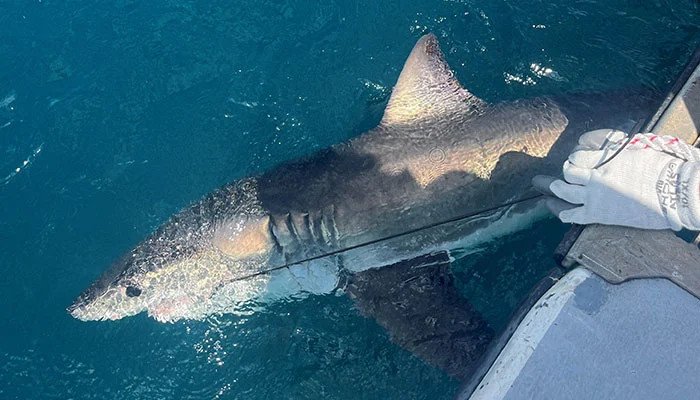
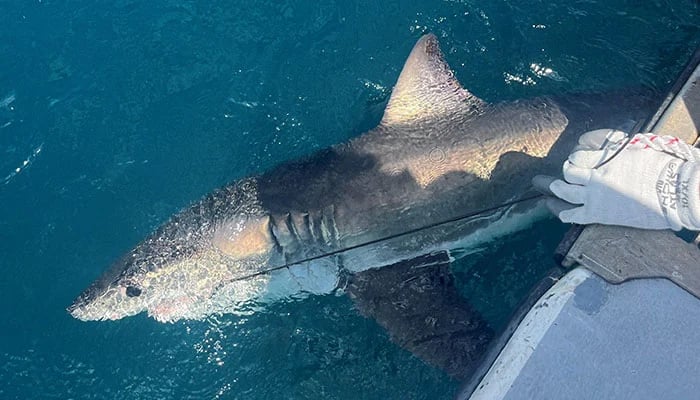
Scientists at the University of Delaware in the US are investigating whether sharks can be used as an observation system to collect ocean data and improve hurricane intensity forecasting.
University of Delaware researchers are installing sensors on sharks that measure ocean temperature, electrical conductivity and depth, electrical conductivity related to the amount of salt in the water.
Animal-mounted sensors have been used successfully in marine research for many years, especially in areas where scientific observations are limited, according to Aaron Carlyle, a professor at the university’s School of Marine Science and Policy who led the research.
The researchers say that sharks are well-suited for this study because they exist in large numbers, are found in large ocean areas and are relatively easy to access compared to many protected marine mammals.
Until now, tagging sharks has been used mostly to determine their movements and habitats, but the new research is selecting sharks that can collect data useful for predicting hurricanes and come close enough to the surface that the tags can transmit the information via satellites.
Preliminary analyzes in the North Atlantic have identified shortfin mako, blue shark, smooth hammerhead and juvenile great white sharks as suitable for this study.
According to Aaron Carlyle, scientists are paying particular attention to the heat in the upper layer of the ocean, known as the ‘mixed layer’.
According to them, this layer of water plays an important role in the intensity of hurricanes, as a warmer mixed layer can lead to stronger hurricanes.
According to Caroline Wernicki, a doctoral student at the University of Delaware, the process of tagging sharks begins in early May, when many migratory shark species come close to shore after spending the winter in remote areas of the Atlantic Ocean.
Researchers take a research boat out to sea 50 to 65 kilometers offshore, where baited lines are cast and wait for sharks, usually two to three hours.
The tag is attached to the dorsal fin of the shark. When the shark swims near the surface of the water, the tag communicates with a network of satellite receivers and transmits data.
According to Carlyle, the tagging process is completed as quickly as a ‘pit crew’ in a motor race and usually takes less than five minutes. Tagging sharks is done under animal care institutional supervision to minimize impact on them.
Tags are attached to materials that dissolve and separate on their own over time. Each shark is also health checked before being released back into the sea, as stressed or injured sharks can affect their natural behavior, potentially affecting the data obtained.
Caroline Wernicki said that sharks are portrayed in movies as very scary, when in reality they are relatively calm animals.
According to the researchers, if the project is successful, the data obtained from the sharks could help improve forecasting of the intensity of hurricanes approaching the US East Coast.
This information will provide coastal communities from North Carolina to Massachusetts with more reliable forecasts for hurricane response and coastal protection.
According to Aaron Carlyle, sharks are amazing animals perfectly adapted to the sea and there is much to learn from them. If it turns out that sharks can be beneficial to humans as well, it will be a win-win situation.