








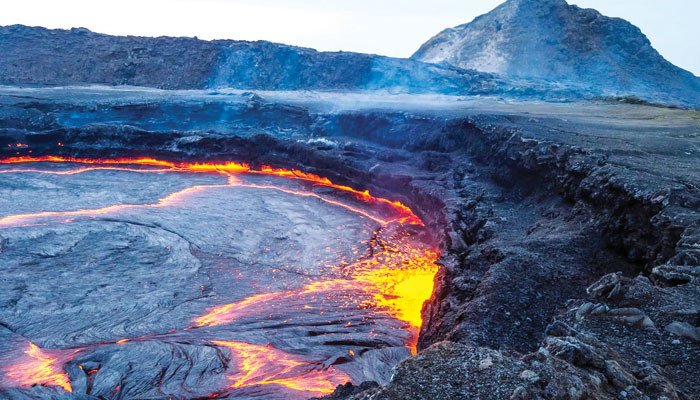
A dead volcano has woken up in Ethiopia after 1200 years, which proves that no volcano is dead, it wakes up at any time and not only in its own country, but also in neighboring countries, which are both negative and positive. This is the reason why volcanologists are constantly warning that wherever there is a dead volcano crater in the world, a crater will kill it. A dumping ground should not be built at all, because it can be active even after thousands of years, as happened in recent days in “Ethiopia”.
Even before this, a 400-year-old volcano erupted suddenly. The factors that work behind it. They are different types of subterranean tectonic plate movements that occur around the world. As for Ethiopia, it is located at the junction of three plates. This is why a rift valley is already present from the movement of the plates in the past.
Since prehistoric times, mankind has been witnessing amazing displays of various natural forces on Earth, one of which is volcanic action, which brings out the secrets of the Earth and reveals the fact that the nature of thermal energy in the deep depths of the Earth is so intense that the solid rock layers are melting into a liquid state.
When this hot liquid hits the earth’s surface, a terrible sound is heard at first. After that, the already quiet and peaceful mountains on the earth become a breeding ground for fire, dust and sparks and in no time engulf and destroy vast areas.
According to a branch of science, “Volcanology”, the source of this type of volcanic phenomena is known as “Core”, which consists of two parts. The heat The inner core has a temperature of 500 to 400°C and is solid like a hot fireball, while the outer core is liquid, with a temperature of around 3700°C that melts the rock containing iron, nickel and other metals into a fluid.
This is called the Earth’s fluid or magma. That is, molten underground rock. Through this, the concentration of “geothermal energy” around the rock layers continues all the time. When this energy exceeds the limit, the magma with great force breaks through the weak parts of the rock layer above it and comes to the surface in the form of a liquid called “lava” which spreads like water mixed with hot cement in the valleys and mountains. This underground process is a long process called volcanism. Through this, a drainage system is formed from the bottom to the top of the earth, which opens on the surface of the earth.
This is the path by which “magma” continues its journey upwards during a volcano, while the crater is the bowl-shaped form from which volcanic materials such as ash, dust, hot water and other pyroclastic rock material and a massive cloud of smoke and water vapor rise upwards (in Ethiopia it is 45,000 feet high). (recorded to the height) covers the entire region and neighboring countries while the “lava” continues to flow from the bowl-shaped rim above and a cone-shaped mountain appears on its sides that may become active and explode at some point. Etna, a volcano in the mountain range north of Sicily, a city in Italy, was immediately followed by a terrifying rumble, followed by thick clouds, ash and sparks from its upper flanks.
It looked like a furnace melting rock bodies under the ground, which was called Vulcanus (Vulcanus) in Latin, the workshop of the god, which changed over time to “Volcano” which was originally associated with Mount Etne, but with the passage of time, it began to be used for all kinds of volcanoes.
As if volcanoes are a powerful “mechanism” of fire spreading underground and as a result of this reaction, rock formations that spread fire and sparks were born, which are called “volcanoes”. While the cooling and freezing of lava from its pointed edges gave rise to volcanic or volcanic mountains, the period of volcanic activity and external manifestations and observations of volcanoes is very ancient.
In the 1960s, the scientist “Alfred Wegener” discovered all these amazing natural phenomena almost accurately, and initially revealed the secret of the earth that the rock layers under the earth keep moving, which was introduced in scientific circles as the theory of “moving continent”, which was echoed in the dimensions, in the light of volcanoes, earthquakes and others. The reasons for the structural changes were largely revealed. This theory of “Alfred Wegener” has been expanded in modern times by the name of the relatively modern theory of plate tectonics, according to which the part of the earth composed of two materials that exists at a depth of 100 kilometers from the surface of the earth. What is called “lithosphere” does not exist in the form of a unit, but consists of small and large plate-like pieces, which are named as “plates” in geological sciences.
The plate is floating on the underlying high-density (5.5) asthenian ambassador, just as many tons of ice or icebergs are seen floating in the ocean. About 20 lithosphere plates of different size and composition have been identified so far, the most prominent being the Cooks, Pacific, Nazca, Philippine and Indian plates.
At a depth of 350 kilometers underground, there is also a part of the earth where the high temperature causes the rocks to become characteristically plastic, which can move easily as if it were in a 1 to 10 percent molten state. This sphere of the earth is called asthenosphere, which is weak, low volatility and high density compared to lithosphere.
The lower part of one (lithosphere) and the upper part of the other (ethnosphere) are connected to each other. This boundary of the Earth’s interior is called the Moho unconformity, where the temperature is so high, that the part of the lithosphere below the surface that hits this zone melts again and turns into “magma”.
In order to understand where and how magma creates volcanoes, modern observations of igneous zones are of particular importance, as igneous zones are directly related to plate movements and collisions. For example, new “basaltic” seafloor is formed in mid-ocean ridges.
In some places the mid-ocean ridge has risen above sea level, thus creating new islands. which have been found to consist of igneous rocks. For example, Iceland and the Philippines where volcanic rocks can be observed. These areas are zones of high heat flux. Heat fluxes have been measured here and it is estimated that the heat flux energy in these regions is twice that of the ocean as a whole.
The Circum Pacific Belt is the area where underwater volcanoes, island arch, underwater volcanic rock ranges and hot spots can be observed exclusively. These are the coastal areas that have America on one side and Southeast Asian countries on the other.
In the light of modern research, the subsurface Pacific plate is moving under the Eurasian plate due to its high density, which has also formed several tectonic plates, due to the heat of which the underlying plate continues to melt, as a result of which “lava” continuously comes out from the sides of the coastal areas and freezes to form new islands, which is said to be the main source of volcanism and subsequent volcanoes.
Despite all the dangerous negative effects, the world has taken into account the economic importance of the volcanic process and its beneficial aspects and used it for many valuable purposes. For example, in “Larderello” (Larderello) in Italy, the steam emitted from the fumarole field around the coastal ranges is used to generate electricity by using a large amount of steam in the power plant. are doing And methane gas is being used as fuel.
Helium gas, which is an inert gas used for melting and cleaning light metals, is also used in balloons because it is lighter than air. In Italy, ammonium carbonate, sodium carbonate and boric acid are also obtained from the steam on the sides of volcanoes, while hydrogen sulphide gas decomposes in the air and turns into water and sulfur deposits.
Apart from this, several secondary chemical products, alum and borax, are also being obtained from the surrounding areas of the volcano, while some volcanic rock is also used for grinding and polishing. For example, pumice, lava, and ash in particular produce very fertile acids, which boost farm productivity.